

Dental implants represent a significant investment in your oral health, with costs ranging from $3,000 to $6,000 per tooth in 2026. Understanding how to navigate insurance claims properly can mean the difference between substantial coverage and paying entirely out of pocket. Unfortunately, many patients and dental practices make preventable errors that lead to claim denials, delayed reimbursements, or reduced benefits. By recognizing these common implant insurance claim mistakes before they happen, you can protect your financial interests and ensure a smoother path to your new smile.
Understanding the Dental Implant Insurance Landscape
Insurance coverage for dental implants has evolved significantly over the past decade. While traditional dental policies historically classified implants as cosmetic procedures, many insurers now recognize them as medically necessary in specific circumstances. The key lies in understanding what your particular policy covers and how to present your case effectively.
The Complexity of Implant Coverage
Most dental insurance plans categorize implants under major restorative procedures, typically covering 50% of costs after deductibles. However, coverage varies dramatically based on several factors:
- Medical necessity documentation: Whether the tooth loss resulted from trauma, disease, or congenital conditions
- Policy limitations: Annual maximums, waiting periods, and frequency restrictions
- Alternative treatment clauses: Some policies only cover the least expensive alternative treatment
- Lifetime maximums: Caps on total implant coverage per insured individual
The challenge intensifies when patients don't realize their policy treats different aspects of the implant procedure separately. The surgical placement, abutment, and crown may each have distinct coverage percentages and coding requirements.
Pre-Authorization Requirements
One of the most critical yet frequently overlooked steps involves obtaining pre-authorization before proceeding with treatment. Approximately 60% of implant claim denials stem from inadequate pre-treatment planning and documentation. Insurance companies require detailed treatment plans, diagnostic records, and clinical justification to approve coverage.
When seeking pre-authorization, submit:
- Comprehensive periodontal examination records
- Recent radiographs showing bone structure and adjacent teeth
- Detailed narrative explaining medical necessity
- Treatment plan with specific procedure codes
- Estimated costs for each phase of treatment
| Pre-Authorization Element | Purpose | Common Mistake |
|---|---|---|
| Clinical photos | Demonstrate tooth loss and surrounding tissues | Submitting poor quality or incomplete images |
| Radiographs | Show bone density and structural integrity | Using outdated films older than 6 months |
| Treatment narrative | Justify medical necessity | Generic explanations without patient-specific details |
| Procedure codes | Identify specific treatments | Using incorrect or outdated CDT codes |

Most Frequent Documentation Errors
Documentation failures represent the leading cause of common implant insurance claim mistakes. Insurance adjusters review thousands of claims monthly, and incomplete or improperly formatted submissions receive immediate denials. Understanding what constitutes complete documentation prevents costly delays and resubmissions.
Incomplete Patient Information
Every claim begins with accurate patient demographics and insurance details. Simple errors like transposed digits in policy numbers or outdated subscriber information trigger automatic rejections. Many practices fail to verify insurance eligibility before each appointment, leading to claims submitted under expired or inactive policies.
Critical patient information to verify:
- Current policy number and group identification
- Subscriber relationship to patient
- Coverage effective dates and renewal periods
- Coordination of benefits with secondary insurance
- Pre-existing condition limitations
The coordination of benefits process becomes particularly complex when patients carry multiple policies. Primary and secondary insurers must receive claims in proper sequence with appropriate notation of other coverage.
Missing or Inadequate Clinical Justification
Insurance companies deny claims when clinical necessity isn't clearly established. A common mistake involves submitting implant claims without explaining why alternative treatments like bridges or dentures proved unsuitable. The narrative must demonstrate that the implant represents the most appropriate treatment option given the patient's specific circumstances.
Effective clinical narratives address these elements:
- Patient history: Document the cause of tooth loss, whether from trauma, periodontal disease, failed root canal, or congenital absence
- Clinical findings: Describe bone quality, soft tissue condition, and occlusal relationships
- Treatment alternatives: Explain why bridges, dentures, or other options are contraindicated
- Long-term prognosis: Discuss how implants prevent bone loss and maintain facial structure
- Patient factors: Note any medical conditions affecting treatment decisions
Radiographic Documentation Deficiencies
High-quality radiographs provide essential evidence supporting implant necessity and proper placement. However, many claims include radiographs that are outdated, poor quality, or incomplete. Insurance reviewers need clear images showing pre-treatment conditions, bone measurements, and post-placement verification.
Standard radiographic requirements include:
- Pre-operative periapical or panoramic films showing missing tooth and adjacent structures
- Bone quality assessment through CT scans or cone beam imaging when applicable
- Post-operative radiographs confirming proper implant positioning
- Follow-up images documenting osseointegration before final restoration
Coding and Billing Complications
Proper procedure coding represents one of the most technical aspects of implant insurance claims. The American Dental Association updates Current Dental Terminology (CDT) codes regularly, and using outdated or incorrect codes guarantees claim rejection. Understanding which codes apply to each phase of implant treatment prevents the common implant insurance claim mistakes that delay payment.
Incorrect CDT Code Selection
Dental implant procedures involve multiple phases, each requiring specific codes. The surgical placement uses different codes than the abutment placement or final crown. Additionally, bone grafting, sinus lifts, and other preparatory procedures have distinct coding requirements.
Primary implant procedure codes:
| Procedure | CDT Code | Description |
|---|---|---|
| Endosteal implant | D6010 | Surgical placement of implant body |
| Abutment placement | D6056-D6057 | Prefabricated or custom abutment |
| Implant crown | D6058-D6067 | Porcelain, ceramic, or metal crown |
| Bone graft | D7950-D7955 | Ridge preservation or augmentation |
| Sinus lift | D7951 | Maxillary sinus augmentation |
A frequent error involves bundling procedures that should be coded separately or unbundling procedures that insurers expect as single codes. Avoiding common dental billing mistakes requires staying current with coding guidelines and payer-specific policies.
Timeline and Sequencing Errors
Insurance policies typically impose strict timelines between implant phases. Submitting claims for the abutment and crown too soon after surgical placement raises red flags. Most insurers require 3-6 months between implant placement and restoration to ensure proper osseointegration.
Similarly, patients must complete prerequisite treatments before insurers approve implant claims. Periodontal disease must be controlled, infections resolved, and bone grafts fully healed. Submitting implant claims before addressing these conditions results in denials.
Fee Schedule Misunderstandings
Many practices struggle with understanding how insurers calculate allowed amounts for implant procedures. Unlike standard procedures with established fee schedules, implants often undergo manual review. The common issues leading to insurance claim rework frequently involve fee disputes and misunderstandings about coverage calculations.
Insurance companies may:
- Apply "least expensive alternative treatment" clauses, paying only what a bridge would cost
- Reduce fees based on their usual, customary, and reasonable (UCR) databases
- Apply annual maximum limitations across multiple procedure phases
- Exclude certain components like custom abutments or premium crown materials
Timing and Submission Strategy Mistakes
When you submit implant insurance claims significantly impacts approval rates and reimbursement amounts. Strategic timing accounts for policy renewal dates, annual maximums, and multi-year treatment planning. Many patients unknowingly sabotage their coverage by poor timing decisions.
Annual Maximum Optimization
Most dental policies impose annual maximum benefits ranging from $1,500 to $3,000. Since implant treatment often exceeds these limits, spreading procedures across calendar years maximizes coverage. However, this strategy requires careful planning and clear patient communication.
Strategic timing considerations:
- Schedule surgical placement in year one to utilize current annual maximum
- Plan abutment and crown placement in year two for fresh benefit allocation
- Complete bone grafting or other preparatory work in advance to preserve implant coverage
- Monitor policy renewal dates to optimize multi-phase treatments
Some families benefit from coordinating treatment timing among family members to avoid exceeding family maximums while individual benefits remain available.
Missing Critical Deadlines
Insurance policies impose strict deadlines for claim submission, typically ranging from 30 to 90 days after service completion. Late submissions face automatic denial regardless of the claim's merit. Unfortunately, practices sometimes delay submission while awaiting additional documentation or resolving patient payment issues.
Additional deadline considerations:
- Pre-authorization expiration: Approvals typically expire after 6-12 months
- Coordination of benefits windows: Secondary insurers require claims within specific timeframes
- Appeal deadlines: Denied claims must be appealed within 30-60 days
- Policy termination dates: Claims for services after coverage ends receive denial

Coordination of Benefits Failures
Patients with dual coverage through employer and spouse plans often encounter coordination of benefits complications. The primary insurer must adjudicate claims first, and secondary claims must include the primary explanation of benefits. Submitting claims in the wrong sequence or failing to note other coverage constitutes dental insurance verification mistakes that delay payment.
Communication and Follow-Up Oversights
Successful insurance claims require proactive communication between the dental practice, patient, and insurance company. Passive approaches where practices simply submit claims and hope for approval lead to unnecessary denials and patient dissatisfaction. Establishing clear communication protocols prevents common implant insurance claim mistakes.
Inadequate Patient Education
Many patients don't understand their insurance benefits, leading to unrealistic expectations about coverage. When claims receive partial payment or denial, unprepared patients may feel misled or refuse to pay their portion. Comprehensive pre-treatment discussions about coverage limitations, out-of-pocket costs, and payment responsibilities prevent these conflicts.
Effective patient education includes:
- Written estimates showing insurance coverage and patient responsibility
- Clear explanations of how annual maximums affect multi-phase treatments
- Discussion of alternative treatment options and their respective costs
- Payment plan options for the patient's portion
- Realistic timelines for insurance processing and reimbursement
At Dental Plus Clinic, our team provides detailed benefit breakdowns before treatment begins, ensuring patients understand their financial commitment for dental implants in Texas.
Failure to Appeal Denied Claims
Approximately 65% of initially denied dental claims receive approval upon appeal, yet many practices never submit appeals. The appeals process requires gathering additional documentation, crafting persuasive narratives, and following strict procedural requirements. Understanding common mistakes that can lead to fraud helps practices submit legitimate appeals without compliance concerns.
Successful appeal strategies:
- Request detailed denial explanations from the insurance company
- Gather additional clinical documentation addressing specific denial reasons
- Obtain peer review support from specialists when applicable
- Submit appeals within required timeframes
- Follow up regularly until receiving final determination
Many denied claims stem from missing information rather than coverage exclusions. A well-constructed appeal with complete documentation often resolves these issues.
Insufficient Follow-Up Systems
Claims disappear into processing backlogs without systematic follow-up. Establishing tracking systems that monitor claim status, identify delays, and trigger follow-up actions significantly improves collection rates. Practices should contact insurers when claims remain unpaid beyond standard processing times, typically 30-45 days.
Modern practice management software can automate follow-up by:
- Flagging claims exceeding processing time standards
- Generating follow-up call lists for administrative staff
- Tracking resubmission attempts and correspondence
- Documenting all communication with insurance companies
- Alerting staff when appeals deadlines approach
Insurance Verification and Eligibility Errors
Verifying coverage before treatment prevents the most costly common implant insurance claim mistakes. Many practices discover coverage issues only after completing treatment, leaving patients with unexpected bills and practices with uncollectible accounts. Comprehensive verification identifies limitations, exclusions, and requirements in advance.
Superficial Benefit Checks
Calling the insurance company and asking "Do you cover implants?" produces misleading information. Many customer service representatives provide generic benefit summaries without reviewing specific policy language, exclusions, or patient-specific limitations. Thorough verification requires requesting detailed written benefit information.
Essential verification questions:
- What percentage does the policy cover for implant surgery (D6010)?
- Are there waiting periods for major restorative procedures?
- Does the policy impose frequency limitations on implant placement?
- How does the policy handle multiple implants in a single arch?
- Are there pre-authorization requirements for implant procedures?
- Does coverage vary based on tooth position or replacement reason?
- What is the current remaining annual maximum?
- Are there lifetime maximums specifically for implants?
Document all verification calls including representative names, reference numbers, and specific information provided. This documentation protects both practice and patient when coverage disputes arise.
Missing Coverage Limitations
Insurance policies contain numerous limitations that aren't apparent during basic eligibility checks. Some policies exclude implants for specific teeth, limit coverage to accident-related tooth loss, or require failed alternative treatments before approving implants. Others impose waiting periods that delay coverage for new policyholders.
| Limitation Type | Common Restrictions | Verification Strategy |
|---|---|---|
| Waiting Periods | 6-24 months for major procedures | Request policy effective date and waiting period schedule |
| Frequency Limits | One implant per site every 5-10 years | Ask about replacement restrictions and timeframes |
| Age Restrictions | No coverage under age 18 or over 65 | Confirm age-related exclusions |
| Medical Necessity | Coverage only for trauma or disease | Clarify acceptable tooth loss reasons |
| Alternative Treatment | Must try bridges or dentures first | Request least expensive alternative policies |
Outdated Insurance Information
Patient insurance status changes frequently through employment transitions, policy modifications, and coverage terminations. Verifying benefits at initial consultation but not reconfirming before treatment leads to denied claims. Best practices include reverifying coverage within 30 days of each major procedure.
Changes to monitor:
- Policy cancellations or terminations
- Annual maximum resets at renewal
- Coverage modifications during open enrollment
- Addition of secondary insurance
- Changes in subscriber employment status
For patients considering dental implants without insurance, alternative payment options should be discussed early in the treatment planning process.
Medical Necessity and Clinical Documentation Standards
Insurance companies approve implant claims based on medical necessity rather than patient preference. The documentation must demonstrate that implants represent the most appropriate treatment option given the patient's clinical presentation. Weak clinical justification represents one of the most prevalent common implant insurance claim mistakes.
Insufficient Diagnostic Records
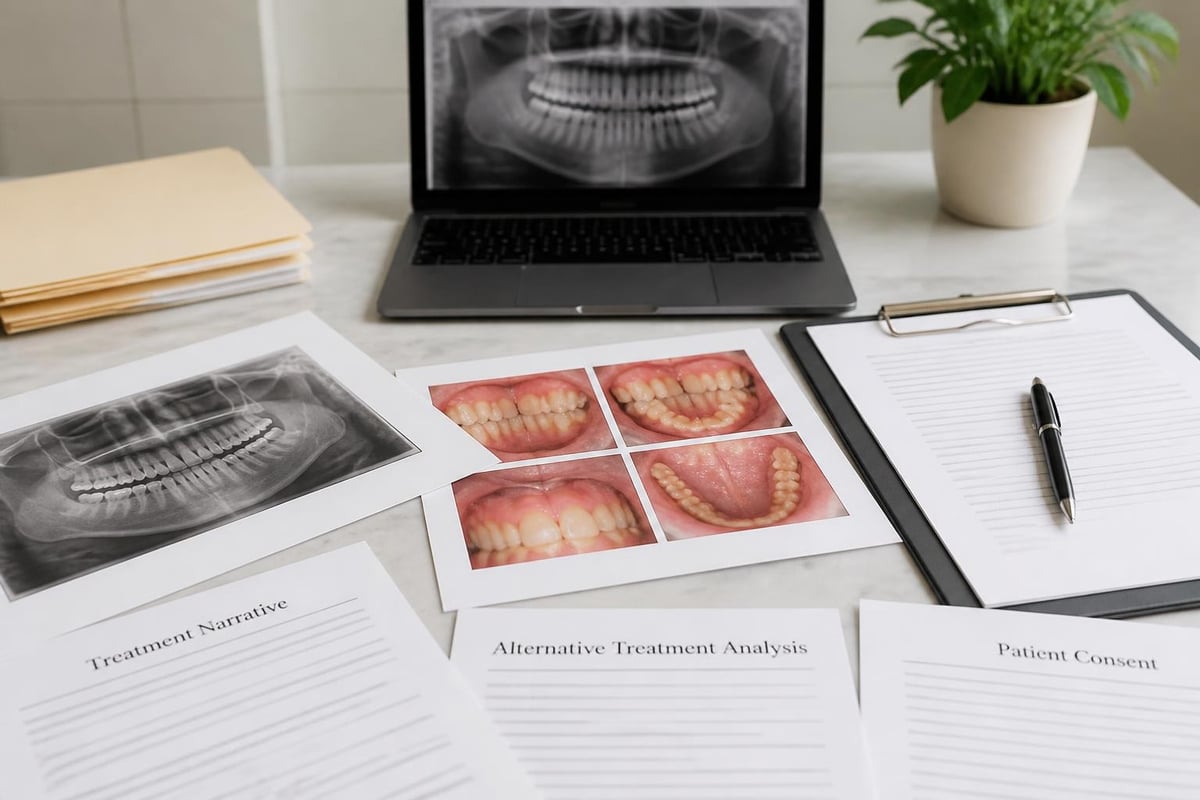
Comprehensive diagnostic records establish the foundation for medical necessity arguments. Insurance reviewers expect complete documentation of the patient's oral condition, including periodontal status, occlusal relationships, bone quality, and overall oral health. Incomplete records suggest cursory examination and inadequate treatment planning.
Required diagnostic documentation:
- Complete periodontal charting showing pocket depths and attachment levels
- Full mouth radiographic survey or panoramic film
- Intraoral and extraoral photographs documenting existing conditions
- Study models or digital scans showing occlusal relationships
- Medical history highlighting conditions affecting treatment options
- Documentation of failed previous treatments when applicable
Advanced imaging like cone beam CT scans provides compelling evidence of bone availability and implant site suitability. While not always required, this technology strengthens medical necessity claims significantly.
Generic Treatment Narratives
Insurance reviewers read hundreds of treatment narratives weekly and immediately recognize generic, template-based explanations. Effective narratives tell the specific patient's story, explaining their unique circumstances and why implants represent the optimal solution. The narrative should address potential reviewer questions proactively.
Elements of persuasive narratives:
- Patient's chief complaint and treatment goals
- Specific cause of tooth loss with supporting documentation
- Clinical findings that contraindicate alternative treatments
- Discussion of patient factors influencing treatment selection
- Long-term prognosis and benefits of implant placement
- Patient's understanding and acceptance of treatment plan
For example, rather than stating "Patient needs implant to replace missing tooth," write: "Patient presents with missing tooth #19 lost to vertical root fracture following failed endodontic retreatment. Adjacent teeth #18 and #20 are sound with no restorations and patient wishes to preserve these teeth, making a bridge unsuitable. Patient's bone quality and quantity support implant placement, offering the most conservative and predictable long-term solution."
Neglecting Alternative Treatment Documentation
Insurance companies frequently invoke "least expensive alternative treatment" clauses, questioning why more expensive implants are necessary when bridges or dentures could restore function. Proactively addressing these alternatives in the treatment plan prevents this objection.
Document specific reasons why alternatives are unsuitable:
- Bridges: Requires preparation of healthy adjacent teeth, patient unwilling to compromise sound tooth structure
- Removable partial dentures: Patient has strong gag reflex, concerns about stability during eating and speaking
- No treatment: Explain consequences of leaving space, including tooth migration and bone loss
This documentation demonstrates thoughtful treatment planning and strengthens the medical necessity argument for implant placement.
Fraud and Compliance Concerns
While most claim errors result from mistakes rather than intentional fraud, certain practices raise compliance concerns with insurance companies and regulatory agencies. Understanding the boundary between aggressive billing and fraudulent activities protects practices and patients from serious consequences.
Upcoding and Unbundling Issues
Upcoding involves billing for more expensive procedures than actually performed, while unbundling separates procedures that should be billed as single units. Both practices constitute fraud when done intentionally. In implant dentistry, common examples include:
- Billing for custom abutments when using prefabricated components
- Separating bone grafting that's inclusive to implant placement
- Coding for complex implant surgery when standard placement occurred
- Billing for CT scans not medically necessary for treatment planning
Selecting the wrong insurance claim form or codes may appear minor but can trigger fraud investigations when patterns emerge. Practices must ensure coding accurately reflects services provided.
Misrepresenting Dates of Service
Altering service dates to maximize insurance benefits or avoid policy limitations constitutes fraud. Common scenarios include:
- Dating services before policy effective dates to avoid waiting periods
- Splitting treatment across calendar years when all services occurred in one year
- Backdating services to fall within policy coverage periods
- Predating claims to meet submission deadlines
Accurate service dating is essential, even when timing negatively affects coverage. Patients should understand policy limitations before treatment rather than relying on date manipulation.
Treating Dentist Identification Errors
Claims must identify the actual treating dentist, not the practice owner or supervising dentist who didn't perform the service. Some practices incorrectly list dentist information to avoid credentialing issues or claim processing delays. This practice violates insurance agreements and can void coverage.
Proper provider identification includes:
- Listing the dentist who performed each specific procedure
- Using correct National Provider Identifier (NPI) numbers
- Ensuring all treating dentists are credentialed with the insurance company
- Documenting any supervised procedures according to state regulations
Technology and Systems Integration Challenges
Modern dental practices rely on practice management software, digital imaging, and electronic claims submission. However, technology introduces new opportunities for common implant insurance claim mistakes when systems aren't properly configured or maintained.
Electronic Health Record Documentation Gaps
Digital records offer tremendous advantages but require disciplined documentation practices. Incomplete template fields, missing attachments, and inadequate narrative documentation weaken insurance claims. Many practices discover documentation gaps only when insurers request additional information.
EHR best practices for implant claims:
- Complete all required fields in treatment planning templates
- Attach relevant images and radiographs to patient records
- Use narrative sections for detailed clinical justification
- Link related procedures to establish treatment sequence
- Document all patient communications regarding treatment and insurance
- Maintain audit trails showing treatment progression
Regular chart audits identify documentation deficiencies before claim submission, allowing corrections while information remains readily available.
Practice Management System Misconfiguration
Incorrectly configured practice management systems generate claims with systematic errors. Common configuration issues include:
- Outdated fee schedules not reflecting current UCR rates
- Incorrect procedure code descriptions or outdated CDT codes
- Missing or incorrect insurance company addresses and clearinghouse information
- Improper coordination of benefits settings
- Template errors that populate incorrect information
Annual system reviews and updates prevent these technical errors from affecting claim success rates.
Clearinghouse and Submission Errors
Electronic claim clearinghouses validate submissions before forwarding to insurance companies. However, clearinghouse edits don't catch all errors, and some catches create false confidence. Practices must understand clearinghouse limitations and implement additional quality checks.
Monitor these clearinghouse metrics:
- Rejection rates by error type
- Average processing times for different claim types
- Response rates from various insurance companies
- Patterns in denial reasons
High rejection rates for specific error types indicate systematic issues requiring correction at the source rather than claim-by-claim fixes.
Frequently Asked Questions
How long does it take for dental implant insurance claims to process?
Standard processing times range from 30 to 60 days for routine claims, though complex implant cases may require 60 to 90 days. Pre-authorization requests typically receive responses within 14 to 21 business days. Delays occur when claims require additional documentation or specialist review.
Can insurance companies deny implant claims after pre-authorization approval?
Yes, pre-authorization represents an estimate of benefits based on submitted information, not a guarantee of payment. Insurance companies can deny claims if the actual treatment differs from the pre-authorized plan, if policy terms change, or if coverage terminates before service completion. However, practices can appeal these denials with supporting documentation.
What percentage of dental implant costs does insurance typically cover?
Coverage varies significantly by policy, ranging from 0% to 50% of implant costs. Most policies that cover implants treat them as major restorative procedures with 50% coverage after deductibles. However, annual maximums of $1,500 to $3,000 limit total reimbursement. Some policies apply "least expensive alternative treatment" provisions, paying only what a bridge would cost.
Should I appeal a denied dental implant insurance claim?
Yes, appealing denied claims often succeeds when additional documentation addresses the denial reason. Statistics show approximately 65% of appealed dental claims receive approval or partial payment. Submit appeals within the required timeframe (typically 30-60 days) with comprehensive clinical documentation and detailed explanation of medical necessity.
How can I verify my dental insurance covers implants before treatment?
Contact your insurance company directly and request written benefit information specific to dental implants. Ask about coverage percentages, waiting periods, annual maximums, frequency limitations, and pre-authorization requirements. Request this information in writing with specific procedure codes (D6010 for implant placement) to ensure accuracy. Your dental practice can also verify benefits on your behalf.
What happens if my insurance claim is denied after I've already paid the dentist?
You remain responsible for payment to the dental practice regardless of insurance claim outcomes. However, you can appeal the denial directly with your insurance company or request the dental practice's assistance with the appeal process. If the appeal succeeds, the insurance company reimburses you directly for covered amounts.
Can I use HSA or FSA funds for dental implants not covered by insurance?
Yes, dental implants qualify as eligible medical expenses for Health Savings Accounts (HSA) and Flexible Spending Accounts (FSA). These tax-advantaged accounts can cover the portion of implant costs not paid by insurance, reducing your overall out-of-pocket expense through pre-tax contributions.
Why do some insurance companies consider implants cosmetic rather than necessary?
Insurance classification depends on the reason for tooth loss and policy language. Companies may deny coverage when tooth loss resulted from neglect or poor oral hygiene rather than trauma, disease, or congenital conditions. Strong clinical documentation establishing medical necessity helps overcome cosmetic classifications.
Understanding Your Policy's Fine Print
Insurance policies contain numerous provisions affecting implant coverage that aren't apparent during benefit verification calls. Taking time to read and understand your specific policy prevents surprises and helps you make informed treatment decisions. Request a complete copy of your dental policy, including all riders, amendments, and exclusions.
Exclusions and Limitations Sections
The exclusions section lists services the policy never covers under any circumstances. Common exclusions affecting implant coverage include:
- Services deemed cosmetic or for appearance purposes only
- Replacement of teeth lost before coverage effective date
- Implants for congenitally missing teeth
- Services related to temporomandibular joint (TMJ) disorders
- Procedures performed outside network provider agreements
Limitations sections describe restrictions on covered services such as frequency limits, age restrictions, and waiting periods. Understanding these provisions helps you plan treatment timing strategically.
Coordination of Benefits Provisions
If you carry multiple dental policies, coordination of benefits provisions determine which policy pays primary and how secondary coverage applies. Most policies use the "birthday rule" for dependent children, designating the parent with the earlier birthday as primary coverage. For dual-coverage adults, the policy held longest typically becomes primary.
Coordination strategies:
- Submit claims to primary insurance first, receiving full adjudication
- Include primary explanation of benefits with secondary claim submission
- Understand that total benefits cannot exceed 100% of covered charges
- Monitor both annual maximums when coordinating multiple policies
Participating Provider Network Requirements
Many policies impose restrictions or reduce benefits for non-network providers. Preferred Provider Organization (PPO) plans typically offer higher reimbursement rates for in-network dentists. Exclusive Provider Organization (EPO) plans may provide no out-of-network benefits.
Before beginning implant treatment, confirm whether your dentist participates in your insurance network and how network status affects your benefits. At our Leander location, we work with most major insurance plans to maximize your coverage.
Maximizing Your Insurance Benefits
Strategic planning significantly increases insurance reimbursement for dental implant treatment. Understanding policy mechanics and timing treatment appropriately can save thousands of dollars while ensuring you receive optimal care.
Multi-Year Treatment Planning
Since dental implants require multiple phases over several months, spreading treatment across calendar years allows you to access fresh annual maximums for different procedure phases. Coordinate with your dental team to structure treatment timing optimally.
Strategic phase timing:
- Year One: Complete diagnostic work, bone grafting if needed, and implant surgical placement
- Healing Period: Allow 3-6 months for osseointegration while annual maximum resets
- Year Two: Complete abutment placement and final crown restoration with fresh benefits
This approach particularly benefits patients with lower annual maximums, effectively doubling available coverage for implant treatment.
Combining Medical and Dental Insurance
Some implant-related procedures may qualify for medical insurance coverage, particularly when tooth loss resulted from trauma, cancer treatment, or congenital conditions. While dental insurance covers routine implant placement, medical policies might cover preparatory procedures like bone grafting or sinus lifts when medically necessary.
Submit claims to medical insurance when:
- Tooth loss resulted from accident or injury
- Bone grafting addresses medical conditions beyond dental restoration
- Treatment addresses congenital abnormalities or developmental disorders
- Procedures relate to cancer treatment or reconstruction
Utilizing Health Savings Accounts Strategically
HSAs and FSAs provide tax-advantaged funding for implant costs exceeding insurance coverage. Contributing the maximum amount to these accounts before undergoing implant treatment reduces your effective out-of-pocket cost by your marginal tax rate plus payroll taxes, often 30-40% total savings.
For 2026, HSA contribution limits are $4,300 for individual coverage and $8,550 for family coverage, with an additional $1,000 catch-up contribution for those 55 and older. Planning contributions around anticipated implant treatment maximizes tax advantages.
Working With Your Dental Practice
Successful insurance claim processing requires partnership between patients and dental practices. Understanding your role in the process and maintaining open communication prevents the common implant insurance claim mistakes that frustrate both parties.
Providing Accurate Information
Supply complete, accurate information at every appointment, including:
- Current insurance cards for all policies
- Updated contact information and address
- Changes in employment or insurance coverage
- Medical history updates affecting treatment planning
- Financial concerns or payment limitations
Notify your dental practice immediately when insurance coverage changes, even mid-treatment. Prompt notification allows the practice to adjust claim strategies and prevent submission errors.
Understanding Financial Responsibilities
Clarify financial arrangements before beginning treatment. Ensure you understand:
- Total estimated treatment costs for all phases
- Expected insurance coverage amounts and percentages
- Your estimated out-of-pocket responsibility
- Payment timing for different treatment phases
- Available payment plans or financing options
Request written treatment plans showing cost breakdowns by procedure phase. This documentation prevents misunderstandings and helps you plan financially for your portion of treatment costs.
Responding to Information Requests Promptly
Insurance companies may request additional information from you directly, particularly regarding accident-related tooth loss or coordination of benefits with other policies. Responding quickly to these requests prevents claim processing delays.
Keep copies of all insurance correspondence and note response deadlines. If you don't understand a request, contact both your dental practice and insurance company for clarification before the deadline passes.
Avoiding common implant insurance claim mistakes requires knowledge, attention to detail, and proactive communication throughout the treatment process. By understanding coverage limitations, documenting medical necessity thoroughly, and partnering effectively with your dental team, you can maximize insurance benefits and minimize out-of-pocket costs for this important investment in your oral health. Whether you're considering All-on-4 vs. All-on-6 dental implants or exploring the latest dental implant technology, our experienced team at Dental Plus Clinic guides you through every step of the insurance process, from pre-authorization through final claim submission, ensuring you receive the maximum benefits available under your policy.