

Understanding what dental procedures are usually covered by insurance can save you hundreds or even thousands of dollars annually. Many Texas families find themselves confused when reviewing their dental benefit statements, unsure whether their upcoming treatment will be covered or leave them with unexpected out-of-pocket expenses. Dental insurance operates differently from traditional medical insurance, with specific coverage tiers, annual maximums, and exclusions that directly impact your wallet. Whether you're scheduling a routine cleaning in Leander or considering more extensive treatment in New Braunfels, knowing your coverage details empowers you to make informed decisions about your oral health and budget effectively for your family's dental care needs.
How Dental Insurance Coverage Actually Works
Dental insurance functions as a benefits program rather than true insurance in the traditional sense. Most plans operate on a reimbursement model with predetermined coverage percentages based on procedure categories.
The structure typically divides services into three main tiers: preventive, basic, and major procedures. Each tier receives different coverage percentages, and most plans impose annual maximum benefits ranging from $1,000 to $2,000 per person. According to research from the National Association of Dental Plans, the average annual maximum has remained relatively stagnant over the past decade despite rising treatment costs.
Understanding these fundamentals helps you anticipate costs before scheduling appointments. Annual maximums reset each calendar year or plan year, meaning unused benefits don't roll over. Deductibles apply to basic and major procedures but typically not to preventive care. Waiting periods may delay coverage for certain procedures, especially if you've recently enrolled in a new plan.
The Three-Tier Coverage System Explained
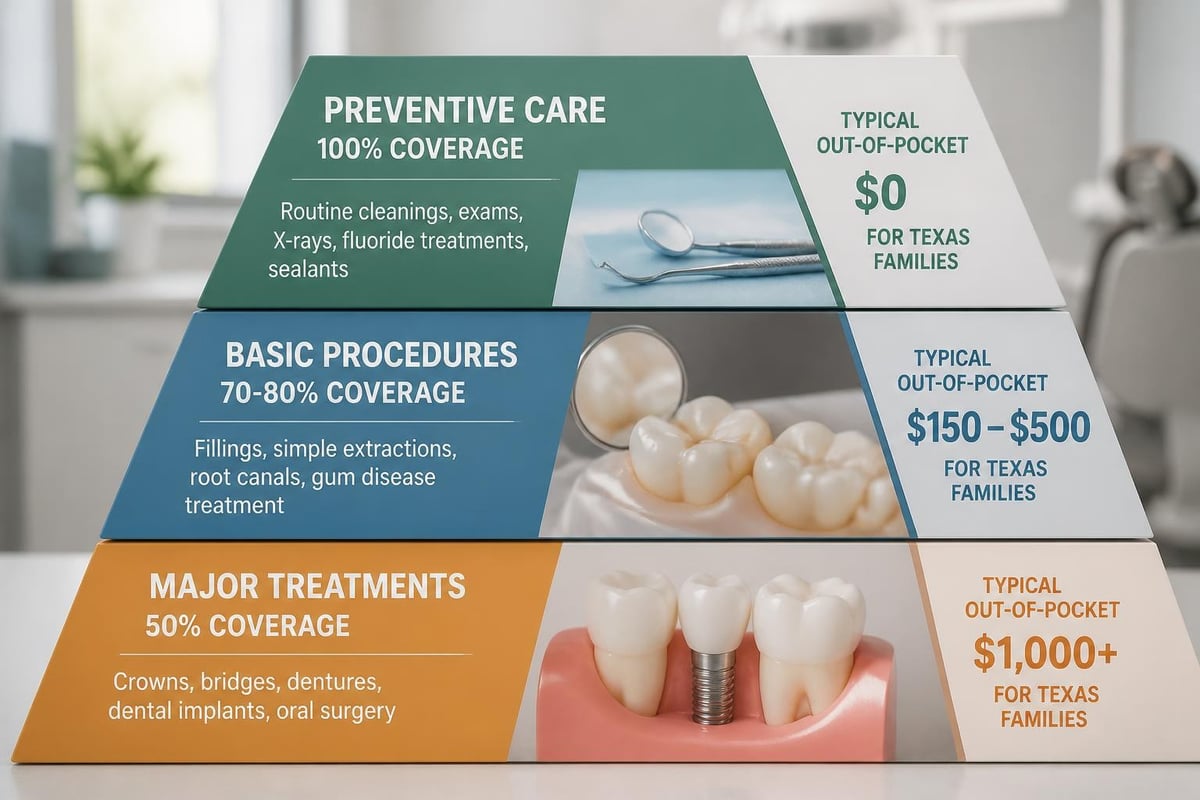
Most dental plans follow a standardized coverage structure that determines what percentage of each procedure the insurance will pay:
| Coverage Tier | Typical Coverage | Common Procedures |
|---|---|---|
| Preventive | 80-100% | Cleanings, exams, X-rays, fluoride treatments |
| Basic | 70-80% | Fillings, simple extractions, periodontal scaling |
| Major | 50% | Crowns, bridges, dentures, root canals, implants |
This tiered approach means preventive care receives the highest coverage to encourage regular dental visits. The American Dental Association explains this benefit structure as designed to promote early intervention and reduce the need for costly major procedures later.
Preventive services form the foundation of dental insurance coverage. These procedures focus on maintaining oral health and preventing disease progression. Most plans cover two cleanings and exams per year at 100%, along with periodic X-rays and fluoride treatments for children.
Basic restorative procedures address common dental problems before they escalate. Coverage typically ranges from 70-80% after meeting your deductible. These services include composite fillings, simple tooth extractions, and non-surgical periodontal treatments that address gum disease in its earlier stages.
Major restorative work receives the lowest coverage percentage, usually around 50%. These procedures are more extensive, technically complex, and expensive. Many patients discover this coverage gap when planning treatments like dental implants, creating financial surprises if they haven't reviewed their policy details beforehand.
What Preventive Dental Procedures Are Usually Covered By Insurance
Preventive care receives the most generous coverage because insurance companies recognize that regular maintenance prevents expensive problems. This category encompasses services designed to keep teeth and gums healthy.
Routine dental examinations are typically covered twice annually at 100%. During these visits, your dentist checks for cavities, gum disease, oral cancer, and other conditions. Early detection during these exams often prevents the need for major procedures later, making them cost-effective for both patients and insurance companies.
Professional teeth cleanings remove plaque and tartar that regular brushing cannot eliminate. Most plans cover two cleanings per year, though some individuals with periodontal disease may qualify for additional cleanings. These appointments also include polishing and education about proper home care techniques.
Diagnostic X-rays help dentists identify problems beneath the surface. Coverage varies by X-ray type:
- Bitewing X-rays: Usually covered once or twice yearly, showing tooth crowns and bone levels
- Panoramic X-rays: Typically covered every 3-5 years, displaying entire jaw structure
- Periapical X-rays: Covered as needed to diagnose specific tooth problems
- Full mouth series: Generally covered every 3-5 years for comprehensive evaluation
Fluoride treatments receive full coverage for children in most plans, strengthening developing teeth and preventing decay. Adult fluoride coverage varies by plan, with some excluding it entirely while others cover it for high-risk patients.
Dental sealants for children are covered by many plans, applied to permanent molars to prevent cavities. These thin protective coatings shield chewing surfaces where decay commonly develops. Some plans limit sealant coverage to children under 14 or 18 years old.
Preventive Services That Maximize Your Benefits
Taking full advantage of preventive coverage helps you avoid needing extensive work later. Schedule your cleanings strategically to use both annual appointments, and don't skip routine exams even if your teeth feel fine.
Parents should prioritize preventive care for children, as many plans offer enhanced pediatric benefits. Early fluoride treatments and sealants can prevent cavities that would otherwise require fillings or more invasive procedures as the child grows.
Adults with a history of gum disease may qualify for more frequent cleanings under periodontal maintenance codes. Discuss this with your dentist, as regular maintenance appointments can prevent disease progression that would eventually require surgical intervention.
Basic Restorative Procedures and Coverage Expectations
Basic procedures address common dental problems with moderate complexity. What dental procedures are usually covered by insurance in this category depends on your specific plan, but most follow similar patterns.
Dental fillings restore teeth damaged by decay, typically covered at 70-80% after your deductible. Modern composite (tooth-colored) fillings have largely replaced amalgam (silver) fillings, though some insurance plans still differentiate between the two. If you choose composite fillings on back teeth where your plan only covers amalgam, you may pay the difference.
Simple extractions remove teeth that can be easily accessed and removed without surgical intervention. Coverage usually mirrors filling percentages, making these procedures relatively affordable with insurance. These extractions often precede orthodontic treatment or address severely decayed teeth that cannot be saved.
Root planing and scaling treat gum disease before it advances to stages requiring surgery. These deep cleaning procedures remove bacteria and tartar below the gum line, helping gums reattach to teeth. Most plans cover periodontal scaling at basic procedure rates when medically necessary, though some require documentation of pocket depths and bone loss.
Oral surgery for simple extractions falls under basic coverage when performed by a general dentist. However, surgical extractions (requiring bone removal or tooth sectioning) often get classified as major procedures with reduced coverage percentages.
Understanding Basic Procedure Limitations
Insurance companies sometimes bundle procedure codes, meaning they won't pay separately for services they consider part of another procedure. For example, a plan might bundle a filling and exam on the same day, paying only for the higher-value procedure.
Pre-authorization requirements may apply to certain basic procedures, especially multiple fillings in one visit. Your dentist's office typically handles this process, submitting treatment plans for approval before performing the work. This prevents surprises but can delay treatment by several days or weeks.
Frequency limitations restrict how often certain procedures receive coverage. Most plans allow only one filling per tooth surface per year, preventing payment for replacing a filling that was recently placed unless failure can be documented.
Major Dental Procedures and 50% Coverage Reality
Major procedures represent the most significant out-of-pocket expenses for insured patients. Understanding what dental procedures are usually covered by insurance at the major level helps you budget appropriately and explore alternative financing when needed.
Dental crowns cap damaged teeth, restoring function and appearance. With typical 50% coverage, a $1,200 crown leaves you responsible for $600 plus any deductible. Some plans distinguish between different crown materials, with porcelain fused to metal and full porcelain options potentially carrying different coverage rates. For families considering extensive dental work, learning about how to reduce dental care costs becomes essential.
Root canal therapy saves infected teeth by removing diseased pulp and sealing the canal system. Coverage typically falls at 50-80% depending on your plan's classification. Front teeth (anterior) root canals sometimes receive higher coverage than molars due to lower complexity and cost.
Bridges replace missing teeth using adjacent teeth as anchors. Traditional three-unit bridges typically cost $2,500-$5,000, with insurance covering approximately half after deductible. This still leaves substantial patient responsibility, particularly for multiple-unit bridges.
Dentures and partial dentures restore function when multiple teeth are missing. Complete dentures and partials usually receive 50% coverage, but plans often impose replacement frequency limits of once every 5-7 years. Immediate dentures placed at the time of extraction may have different coverage than conventional dentures fitted after healing.

Dental Implants and Coverage Challenges
Dental implants present unique coverage challenges. Many insurance plans exclude implants entirely or provide minimal benefits, classifying them as cosmetic or elective despite their functional advantages. When coverage exists, it typically applies only to the crown portion, not the surgical implant placement.
The cost of dental implants with insurance varies significantly based on your plan's specific provisions. Some patients find that choosing between in-network vs. out-of-network dentists dramatically impacts their final costs for implant procedures.
Patients should understand that even when insurance covers implants, annual maximums quickly get exhausted. A single implant procedure might exceed your entire year's benefits, leaving you responsible for most costs. Planning implant treatment across calendar years can maximize benefits if your dentist can stage the surgical and restorative phases.
Annual Maximum Impact on Major Work
Annual benefit maximums create the biggest limitation for major procedures. When your dentist recommends multiple crowns, root canals, or implants, your $1,500 annual maximum might only cover one or two procedures even with 50% coverage.
Strategic treatment planning helps maximize your benefits:
- Prioritize urgent needs in the current year and schedule elective work for the next benefit period
- Coordinate with your dentist to spread treatment across calendar years when clinically appropriate
- Consider supplemental insurance or discount plans if you need extensive work
- Explore payment plans for amounts exceeding your annual maximum
Many Texas families face decisions about staging treatment to optimize insurance benefits versus completing necessary work promptly. Your dentist can help prioritize procedures based on clinical urgency and benefit maximization.
What Dental Procedures Are Usually Not Covered
Understanding exclusions prevents disappointment when filing claims. Most dental insurance plans specifically exclude certain categories of care, regardless of medical necessity.
Cosmetic dentistry receives minimal or no coverage from traditional insurance plans. Procedures performed purely for aesthetic improvement without restoring function typically fall outside coverage parameters:
- Teeth whitening and bleaching procedures
- Veneers placed solely for appearance
- Cosmetic bonding to improve tooth shape or color
- Gum reshaping for smile aesthetics
- Orthodontics for adults (though some plans offer limited adult ortho benefits)
Some cosmetic procedures serve dual purposes. When cosmetic dental treatment also restores function, partial coverage may apply. For example, a crown needed after root canal therapy receives coverage even though it improves appearance.
Orthodontic treatment varies widely by plan. Many employer plans exclude orthodontics entirely, while others provide separate lifetime maximums ranging from $1,000-$3,000. Pediatric orthodontic coverage is more common than adult coverage, and waiting periods often extend 12 months before benefits activate.
Implants and advanced procedures face frequent exclusions or limitations:
| Procedure | Typical Coverage Status |
|---|---|
| Single tooth implants | Often excluded or limited to crown only |
| All-on-4 implants | Usually excluded entirely |
| Bone grafting | Excluded unless required for covered procedure |
| Sinus lifts | Typically excluded as preparatory procedure |
| TMJ treatment | Often excluded or severely limited |
Patients exploring options like All-on-4 dental implants or full mouth dental implants should anticipate limited insurance participation and plan accordingly.
Experimental and Non-Standard Treatments
Insurance plans exclude procedures they classify as experimental, investigational, or not proven effective through clinical research. Latest dental implant technology may face coverage denials until sufficient evidence supports the techniques.
Athletic mouthguards and other preventive appliances beyond standard coverage receive minimal benefits. While some plans cover nightguards for documented bruxism (teeth grinding), custom sports mouthguards typically aren't covered.
Replacement of lost or stolen prosthetics within the coverage frequency period usually results in denial. If your dentures are damaged in an accident within the 5-year replacement window, you'll likely pay full cost for new ones.
Special Coverage Situations and Plan Variations
Not all dental insurance operates on the traditional PPO model. Understanding plan types helps you anticipate coverage differences and make informed choices during open enrollment.
Dental HMO plans (DHMO) require you to select a primary dentist from the network and typically don't cover out-of-network care. These plans often provide more generous coverage percentages but restrict provider choice. The National Association of Dental Plans explains different benefit types and how network structures affect your costs and access to care.
Indemnity plans offer maximum provider flexibility, allowing you to visit any licensed dentist. However, these plans typically have lower coverage percentages, higher deductibles, and may reimburse based on "usual and customary" rates rather than actual charges, leaving you responsible for differences.
Discount dental plans aren't insurance at all but membership programs offering reduced fees at participating dentists. These work well for individuals who need extensive work exceeding annual maximums or whose employers don't offer dental insurance. Texas residents without employer coverage might combine discount plans with careful budgeting for major procedures.
Medicare and Medicaid Coverage Differences
Original Medicare does not cover routine dental care, creating significant gaps for seniors. According to Medicare.gov, coverage exists only when dental procedures are integral to covered medical procedures or when complications arise from dental work. Routine cleanings, fillings, dentures, and extractions receive no Medicare benefits.
Seniors should explore:
- Medicare Advantage plans that may include dental benefits
- Standalone dental insurance designed for retirees
- Discount dental programs offering reduced fees
- Payment plans at dental practices serving seniors
Many Texas seniors discover that tooth replacement options for seniors require significant out-of-pocket investment unless they've secured supplemental dental coverage.
Medicaid dental coverage varies dramatically by state. Texas Medicaid provides comprehensive dental benefits for children through the Early Periodic Screening, Diagnostic and Treatment (EPSDT) program. Adult coverage is more limited, typically restricted to emergency services and extractions. The CMS guidance on children’s dental requirements emphasizes the importance of pediatric oral health in public programs.

Maximizing Your Dental Insurance Benefits in 2026
Strategic use of dental insurance requires planning and understanding your policy's fine print. Many Texas families leave benefits unused simply because they don't schedule appointments or understand what qualifies for coverage.
Know your plan's specific details by reviewing your Summary of Benefits or calling your insurance company. Ask these critical questions:
- What is my annual maximum and when does it reset?
- What are my deductibles for basic and major procedures?
- How many preventive visits do I get per year?
- Are there waiting periods for major procedures?
- What percentage does my plan cover for each category?
- Are there frequency limitations on specific procedures?
Use preventive benefits fully by scheduling your allowed cleanings and exams. Missing these appointments wastes coverage that doesn't roll over and may lead to problems requiring more expensive treatment later. Parents should prioritize their children's preventive appointments, including sealants and fluoride treatments when covered.
Time major procedures strategically if you need extensive work. When facing multiple crowns or root canals, work with your dentist to stage treatment across benefit years when clinically appropriate. This approach maximizes your annual maximum utilization, though urgent procedures shouldn't be delayed for financial optimization.
Working with Your Dental Team
Your dentist's administrative team serves as your advocate in navigating insurance complexities. Pre-treatment estimates provide written breakdowns of expected coverage and your financial responsibility before procedures begin. While not guarantees, these estimates help you budget appropriately.
Clear communication about your insurance situation helps your dental team recommend appropriate treatment timing. If approaching your annual maximum, your dentist might suggest prioritizing clinically urgent procedures and deferring elective work until benefits reset.
Payment plans and financing options bridge gaps when treatment costs exceed insurance coverage. Many dental practices offer in-house payment plans or work with healthcare financing companies. Some patients find that understanding dental implants without insurance options opens treatment possibilities they thought were financially impossible.
The Consumer Financial Protection Bureau provides guidance on medical credit cards and payment plans, including important considerations before signing financing agreements for dental care.
Navigating Claims and Appeals Processes
Understanding what dental procedures are usually covered by insurance includes knowing how to handle claim denials and disputes. Not every denial means you're responsible for the full cost.
Common reasons for claim denials include:
- Missing or incomplete information on the claim form
- Lack of pre-authorization for procedures requiring approval
- Frequency limitations when procedures occur too soon after previous treatment
- Exclusions for non-covered services
- Annual maximum exhaustion leaving no benefits remaining
- Coding errors that misrepresent the actual procedure performed
The appeals process gives you recourse when you believe a denial was incorrect. Start by requesting a detailed explanation of benefits (EOB) showing why the claim was denied. Compare this against your policy's coverage provisions.
Most insurance companies have multi-level appeals processes:
- Initial reconsideration where you submit additional documentation supporting coverage
- Formal appeal with detailed explanation and supporting clinical notes from your dentist
- External review through your state's insurance department if internal appeals fail
Your dentist's office can provide clinical documentation justifying medical necessity, photographs showing damage or disease, and detailed treatment notes supporting coverage. X-rays, periodontal charts, and diagnostic records strengthen appeals by demonstrating that procedures weren't cosmetic or elective.
When to Escalate Insurance Disputes
State insurance departments regulate dental insurance companies and can intervene when companies violate coverage provisions or deny valid claims. Texas residents can file complaints with the Texas Department of Insurance when facing unreasonable denials or processing delays.
Professional associations like the American Dental Association provide resources for understanding coverage standards and patient rights. Your dentist may consult these resources when advocating for your coverage.
Documentation is critical throughout the appeals process. Keep copies of all correspondence, take notes during phone calls (including date, time, and representative names), and save every EOB and denial letter. This paper trail supports escalation if needed.
Frequently Asked Questions About Dental Insurance Coverage
Does dental insurance cover dental implants?
Most traditional dental insurance plans provide limited or no coverage for dental implants, often classifying them as cosmetic or elective procedures. When coverage exists, it typically applies only to the crown portion rather than the surgical implant placement. Some plans may cover implants when they're the only viable option for tooth replacement due to medical conditions preventing other solutions. Patients should review their specific policy and consider that understanding whether dental insurance covers dental implants requires examining both plan provisions and individual circumstances.
How often will insurance pay for dental cleanings?
The vast majority of dental insurance plans cover two preventive cleanings per year at 100% with no deductible. These cleanings must typically occur at least six months apart to qualify for full coverage. Patients with periodontal disease may qualify for additional periodontal maintenance cleanings beyond the standard two, though these sometimes fall under basic rather than preventive coverage with different cost-sharing percentages.
What happens if I exceed my annual maximum?
Once you reach your plan's annual maximum (typically $1,000-$2,000), you're responsible for 100% of any additional dental costs for the remainder of the benefit year. These maximums don't roll over, so unused benefits expire at year-end. Patients facing costs beyond their maximum should discuss payment plans with their dentist or consider timing elective procedures to coincide with benefit year resets.
Are wisdom teeth extractions covered by dental insurance?
Coverage for wisdom teeth removal depends on whether the extraction is classified as simple or surgical. Simple extractions typically receive basic procedure coverage (70-80%), while impacted wisdom teeth requiring surgical removal often fall under major procedures (50% coverage). Some plans cover medically necessary wisdom teeth removal at higher percentages, particularly when infection, cyst formation, or damage to adjacent teeth exists. Pre-authorization is commonly required for surgical extractions.
Can I use dental insurance immediately after enrolling?
Preventive services typically have no waiting period, meaning you can schedule cleanings and exams immediately after enrollment. However, basic procedures often have 3-6 month waiting periods, while major procedures may require 6-12 months of continuous coverage before benefits activate. These waiting periods prevent individuals from enrolling only when they need expensive treatment and then canceling coverage afterward.
What's the difference between dental PPO and HMO plans?
PPO (Preferred Provider Organization) plans allow you to visit any dentist but offer higher coverage when using in-network providers. You don't need referrals and can see specialists directly. HMO (Health Maintenance Organization) plans require you to choose a primary dentist from the network, typically don't cover out-of-network care, and may require referrals for specialists. HMO plans often have lower premiums and more generous coverage percentages but less provider flexibility.
Will insurance cover replacing old fillings?
Insurance typically won't cover replacing fillings that are still functioning properly, viewing this as elective. However, when fillings fail due to recurrent decay, fracture, or marginal breakdown, replacement receives coverage at the basic procedure rate. Your dentist must document the failure reason for insurance approval, often including X-rays or photographs showing defects. Most plans also impose frequency limitations preventing replacement of the same tooth surface within a year unless failure can be clearly documented.
Does dental insurance cover emergency visits?
Emergency dental care coverage depends on what procedures are performed during the visit. The emergency exam itself typically receives preventive or basic coverage, but necessary treatments follow standard coverage percentages based on procedure type. Emergency root canals, extractions, or temporary restorations are covered at their respective category rates. Some plans charge higher copays for after-hours emergency care or require authorization for non-urgent treatments performed during emergency visits.
How do I find out what my specific plan covers?
Review your Summary of Benefits document provided during enrollment, which outlines coverage percentages, annual maximums, deductibles, and exclusions. Call the customer service number on your insurance card with specific questions about procedure coverage. Your dentist's office can also verify benefits by contacting your insurance company directly, often providing pre-treatment estimates showing expected coverage and your anticipated out-of-pocket costs for planned procedures.
Can I get dental insurance if I'm self-employed?
Self-employed individuals can purchase individual dental insurance plans directly from insurance companies or through the Health Insurance Marketplace, though dental coverage isn't included in marketplace health plans. Many professional associations and business organizations offer group dental plans to members. Alternatively, discount dental plans provide reduced fees without the limitations of traditional insurance, which may be cost-effective for self-employed individuals anticipating significant dental needs. Resources like best dental insurance plans in Texas can help self-employed Texans compare available options.
Understanding Plan Networks and Provider Choices
Network participation significantly affects your out-of-pocket costs even when procedures are covered. In-network dentists have negotiated fee schedules with insurance companies, agreeing to accept specific amounts as payment in full after the plan pays its portion.
Out-of-network providers can charge their full fees without contractual limitations. While your insurance may still provide benefits, they're often calculated based on "usual and customary" rates that may fall below the dentist's actual charges. You'll pay the difference between what insurance covers and what the dentist charges.
The financial impact varies by procedure:
| Procedure | In-Network Cost | Out-of-Network Cost | Difference |
|---|---|---|---|
| Cleaning | $0 (100% coverage) | $0-50 (depends on UCR) | $0-50 |
| Filling | $50-100 (80% coverage) | $100-200 (lower reimbursement) | $50-100+ |
| Crown | $400-600 (50% coverage) | $600-900 (lower reimbursement) | $200-300+ |
Balance billing occurs when out-of-network dentists bill you for amounts exceeding insurance reimbursement. While you receive some insurance benefit, the total out-of-pocket cost often exceeds what you'd pay visiting an in-network provider.
Evaluating Provider Networks During Plan Selection
Network size matters when choosing dental insurance during open enrollment. Plans with limited networks may offer lower premiums but restrict your provider choices. Before enrolling, verify that dentists convenient to your home or work participate in the network.
Provider directories available online aren't always current, with dentists joining or leaving networks throughout the year. Call your preferred dental office directly to confirm current network participation before assuming coverage levels.
Multiple locations benefit families living in different Texas cities or those who split time between locations. Dental Plus Clinic's five Texas locations in Beeville, Seguin, New Braunfels, Leander, and Converse provide network access across central and southern Texas for many major insurance carriers.
Planning for Major Dental Work with Insurance
When your dentist recommends significant treatment, understanding what dental procedures are usually covered by insurance helps you prepare financially and make informed decisions about timing and treatment options.
Comprehensive treatment plans outline all recommended procedures, associated costs, and ideal sequencing. Your dentist's office can submit pre-authorization requests for major work, receiving estimated coverage confirmations before beginning treatment. While pre-authorizations aren't guarantees, they provide reliable financial planning information.
Alternative treatment options may offer different cost-benefit ratios depending on your coverage. For example, a dental bridge might receive better coverage than an implant for replacing a single tooth, though implants often provide superior long-term value. Discussing both clinical and financial considerations helps you make decisions aligned with your health goals and budget.
Treatment staging strategies maximize insurance benefits:
- Front-load urgent procedures in the current year while benefits remain
- Schedule elective work early in the new benefit year
- Coordinate with benefit resets to access two years of maximum benefits for extensive treatment
- Consider phased approaches for full mouth rehabilitation or multiple implants
The long-term value of certain treatments may justify out-of-pocket investment beyond insurance coverage. Resources like why dental implants are a long-term investment help patients understand total lifetime costs versus upfront expenses when evaluating tooth replacement options.
Public Misunderstandings About Dental Insurance
Many patients hold misconceptions about how dental insurance works, leading to frustration when coverage doesn't meet expectations. According to research on public misunderstanding of dental insurance, widespread confusion exists about coverage limits, benefit structures, and the difference between medical and dental insurance.
Common misconceptions include:
- Believing dental insurance covers everything after the deductible
- Expecting unlimited annual benefits similar to medical insurance out-of-pocket maximums
- Assuming all necessary procedures automatically qualify for coverage
- Not understanding that premium costs don't correlate to benefit generosity
- Expecting insurance to pay for treatment to fix long-neglected dental problems immediately
Realistic expectations help patients use their benefits effectively while understanding limitations. Dental insurance provides valuable assistance with routine care and helps offset major procedure costs, but rarely covers 100% of significant dental work. Viewing dental insurance as a maintenance benefit rather than comprehensive coverage aligns expectations with reality.
Understanding what dental procedures are usually covered by insurance empowers you to maximize your benefits while planning appropriately for out-of-pocket expenses. Whether you need preventive care fully covered by your plan or major procedures requiring significant cost-sharing, knowing your coverage details helps you make informed decisions about your oral health. At Dental Plus Clinic, our experienced team works with most major insurance carriers to verify your benefits, submit claims efficiently, and provide transparent cost estimates before treatment begins. With convenient locations throughout Texas in Beeville, Seguin, New Braunfels, Leander, and Converse, we're committed to helping you achieve optimal oral health while making the most of your dental insurance benefits. Schedule your appointment today to discuss your treatment needs and discover how we can help you navigate insurance coverage for the care you deserve.