
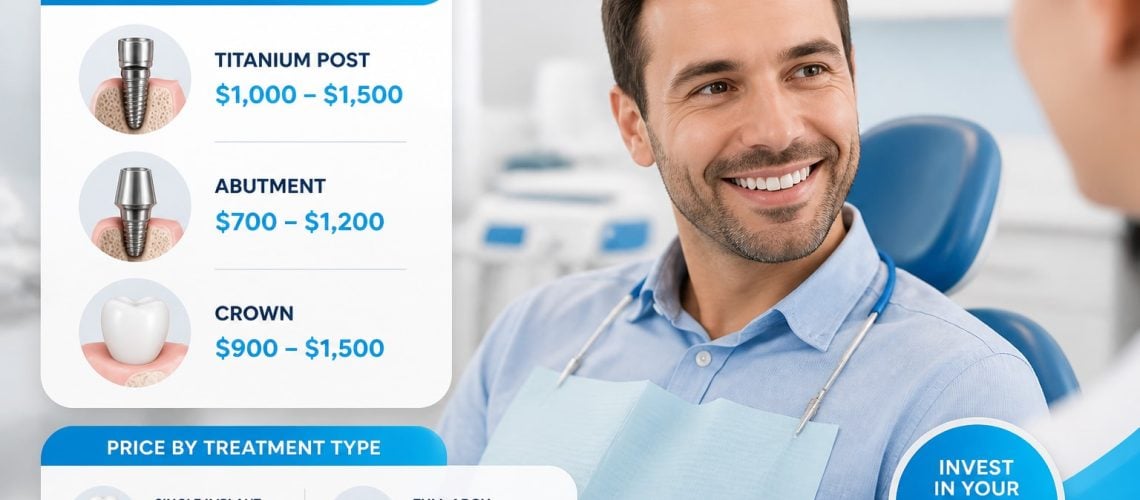
The cost to implant teeth varies by case and rises for multiple teeth or a full arch. A 2025 survey of 278 dental practices reported a national median of $4,000 for a complete single implant, including the implant, abutment, and crown, according to Dental Economics. Your own total depends on how many teeth you are replacing, the condition of your jawbone, and the type of restoration you choose.
This guide explains what is in the price, which factors move it up or down, what insurance usually covers, and how families and adults in Seguin, Converse, Beeville, New Braunfels, and Leander can plan for it.
How Much Does It Cost to Implant Teeth in Texas?
Single complete implants often fall in the mid-thousands of dollars, and full-arch replacement costs more. These are planning ranges rather than quotes, because every mouth is different.
The most reliable public benchmark comes from the 2025 Dental Economics survey, which put the national median for a complete single implant at $4,000. The same survey reported an average of $3,665 in Houston, a Texas city, which suggests that pricing there can sit below the national median.
Here is a general overview of what patients commonly see:
| Treatment | Typical Range (Complete) | What It Replaces |
|---|---|---|
| Single implant with crown | Commonly several thousand dollars | One missing tooth |
| Implant-supported bridge (2 to 3 implants) | $6,000 to $15,000 | Three to four teeth |
| Implant-supported full arch | $12,000 to $30,000+ | All upper or lower teeth |
| Implant-retained denture | $8,000 to $20,000 | A full arch, removable |
These ranges reflect common market patterns and are not a price list. The only number that matters for your budget is the one written in your own treatment plan. If you want to see how single-tooth pricing breaks down in more detail, the clinic's page on single dental implant cost is a useful next read.
What Is Included in the Price of a Dental Implant?
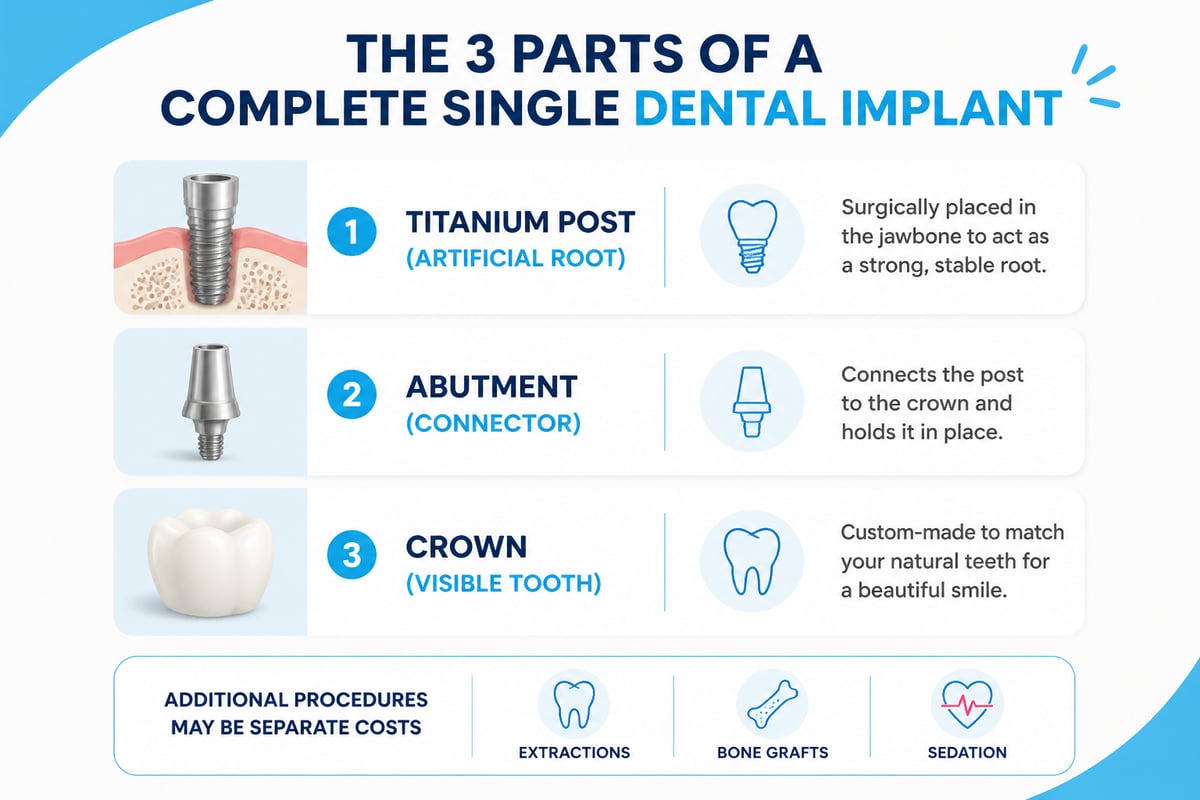
A complete implant price covers three core parts: the titanium post placed in the jaw, the abutment that connects the post to the tooth, and the crown you see when you smile. A fair quote should make clear whether all three are included.
Each part plays a distinct role:
- The implant post. A small titanium screw that acts as an artificial tooth root. It fuses with the jawbone over several months.
- The abutment. A connector that attaches to the post and holds the crown in place.
- The crown. The visible tooth, usually made of porcelain or zirconia, shaped and shaded to match your natural teeth.
Beyond those three parts, some costs sit outside the base price. Ask whether your quote includes:
- The consultation, exam, and 3D imaging
- Tooth extraction, if a failing tooth must come out first
- Bone grafting or a sinus lift, if the jaw needs rebuilding
- Sedation or anesthesia options
- Follow-up visits and a temporary tooth during healing
A low headline number can look attractive and then grow as these items are added. Clear, itemized pricing before treatment starts is the simplest protection against surprise bills.
How Much Should a Single Tooth Implant Cost?
A single tooth implant's cost for the post, abutment, and crown together varies by practice and case, before any extra procedures. If a quote seems unusually low, ask what has been left out. If it seems unusually high, ask what justifies it.
A single implant is a common starting point for patients, and it is also one of the simpler cases to price. Consider a typical example. A parent in Seguin chips a molar badly enough that it cannot be saved. After extraction and healing, an implant with a porcelain crown replaces it. The cost usually breaks down into the extraction, the implant surgery, and the final crown placed a few months later.
Several details can shift a single-implant price:
- Tooth location. Molars carry more chewing force and often need a larger crown than front teeth.
- Crown material. Zirconia and layered porcelain cost more than basic options but may look more natural.
- Existing bone. Strong bone means a simpler procedure. Thin bone adds steps.
You can read a fuller breakdown of one-tooth pricing on the clinic's page about dental implant cost.
What Factors Change the Cost to Implant Teeth?
Five main factors change the cost to implant teeth: the number of teeth being replaced, the type of restoration, the implant material, any preparation procedures, and where the work is done. Understanding these helps you read a quote with confidence.
Number of teeth and type of restoration
Replacing one tooth costs far less than replacing a full arch, but the price does not scale in a straight line. A bridge supported by two or three implants can replace several teeth at a lower cost per tooth than placing one implant for each. Full-arch options such as All-on-4 dental implants use a small number of strategically placed implants to support a whole row of teeth.
Implant material
Titanium is the long-standing standard and has the deepest track record. Zirconia is a metal-free ceramic alternative that some patients prefer for appearance or metal sensitivity, and it generally costs more. The clinic's comparison of zirconia vs titanium implants explains the tradeoffs.
Preparation procedures
Mayo Clinic notes that the type of implant and the condition of your jawbone help determine how dental implant surgery is performed. That is why a scan comes before any quote. Common prep procedures include:
- Bone grafting, which rebuilds jawbone lost to long-term tooth loss or denture wear
- Sinus lifts, which create room for upper back implants
- Extractions, including wisdom teeth removal if needed for a clean surgical site
Location and lab costs
Pricing varies by city and by practice. Clinics that make crowns and bridges in house can often reduce delays and outside lab fees, which matters when a restoration has to be finished on schedule.
Why Are Dental Implants More Expensive Than Other Options?
Dental implants cost more up front because they involve surgery, specialized materials, a custom-made crown, and several months of healing and follow-up. You are paying for a replacement root and tooth, not just a visible cover.
Implants also require trained clinicians and careful planning. Dr. Tejash Patel of Dental Plus Clinic received the Kenneth D Rudd Award for earning more than 200 continuing education courses in one year, an example of the ongoing training that advanced procedures call for.
The higher price buys something specific. An implant stands on its own without relying on neighboring teeth, and it helps preserve the jawbone beneath it. Many patients find the value clearer over time, a point explored in the clinic's article on whether dental implants are worth the cost.
Is There a Cheaper Alternative to Dental Implants?
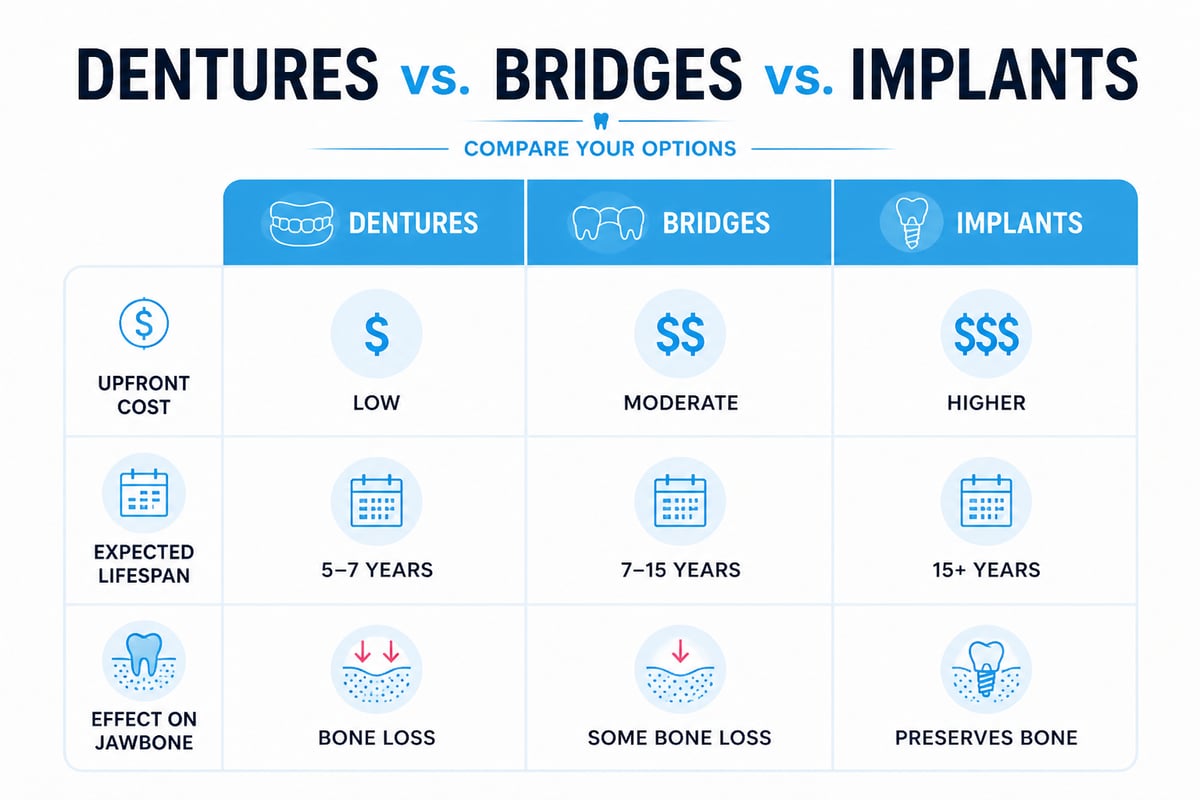
Yes. Dentures and dental bridges cost less up front than implants, though they come with different long-term tradeoffs. The right choice depends on your budget, your oral health, and how many teeth you are replacing.
Here is how the main options compare:
| Option | Typical Upfront Cost | Typical Lifespan | Key Tradeoff |
|---|---|---|---|
| Removable partial or full denture | Lowest | Varies with care | Can slip, needs relining, does not protect the jawbone |
| Fixed bridge | Moderate | Varies with care | Requires shaping healthy neighboring teeth |
| Single implant | Higher | Can last many years with care | Highest upfront cost, no impact on adjacent teeth |
| Mini implants | Moderate | Varies | Smaller posts, not suitable for every bite load |
Adults with ill-fitting or failing dentures often find that daily frustrations such as sore gums, foods they avoid, and worry about a loose plate in public matter as much as the price. For those patients, a hybrid such as an implant-retained denture can improve stability at a cost below a full fixed arch. The clinic's guides on dental implants vs dentures and mini dental implants vs traditional implants go through the details.
A cheaper option is not automatically a better deal. A denture that needs replacing twice may cost as much over time as one implant. Likewise, the cheap vs premium dental implants discussion is worth reading before you choose based on price alone.
How Long Do Teeth Implants Last?
A well-placed implant can last many years, and often a lifetime with good care. The titanium post is rarely the part that wears out. The crown on top may need replacing over time because of normal chewing wear.
Longevity depends on habits you control:
- Brushing twice daily and flossing around the implant
- Keeping regular cleanings and exams
- Avoiding tobacco, which raises the risk of implant failure
- Managing conditions such as diabetes and gum disease
- Wearing a night guard if you grind your teeth
Spread over many years, the yearly cost of an implant can fall well below what it first appears.
How Painful Is Dental Implant Surgery?
Most patients report that dental implant surgery is far less painful than they expected, because the area is fully numbed and sedation is available for anxious patients. Soreness afterward is usually mild to moderate and manageable with over-the-counter medication.
During the procedure, you should feel pressure but not pain. Afterward, expect some swelling, minor bruising, and tenderness for a few days. Most people return to normal routines within a day or two, though full bone healing takes months.
Fear of pain is one of the most common reasons adults delay treatment, even while living with broken teeth or loose dentures. Telling your dentist about that fear up front allows the team to plan sedation and a comfortable schedule. Reviewing the dental implant recovery timeline beforehand also helps remove uncertainty.
Does Insurance Cover the Cost of Dental Implants?
Some dental insurance plans cover part of the cost of dental implants, but many exclude them or cap benefits at a low annual maximum. Coverage varies widely, so verify your specific plan before you assume anything.
A typical plan might cover a portion of related procedures, such as extractions, bone grafts, or the crown, even if it does not cover the implant itself. Annual maximums are often modest, which may cover only a fraction of the total.
Questions worth asking your insurer:
- Are implants a covered benefit, or are they excluded?
- Does the plan cover extractions, grafts, or crowns separately?
- What is the annual maximum, and how much is left this year?
- Is there a waiting period for major procedures?
The clinic has more detail on the cost of dental implants with insurance and a side-by-side look at implant cost with and without insurance. Timing matters too. If your benefits reset each January, splitting treatment across two plan years can sometimes stretch your coverage further.
How Can You Pay for Dental Implants?
You can pay for dental implants through insurance benefits, in-office payment plans, third-party financing, health savings accounts, and phased treatment. Most patients combine two or more of these.
Practical ways to manage the cost:
- Use your HSA or FSA. Pre-tax dollars can reduce the real price of qualifying dental work.
- Phase the treatment. Extractions and grafts can be done first, with the implant and crown following later.
- Ask about financing. Monthly payment plans spread the expense across time. The clinic outlines its dental implant financing options in Texas.
- Prioritize preventive care. Keeping the rest of your teeth healthy lowers future costs, as described in the clinic's tips on reducing your dental care costs.
A common worry is that financing means hidden fees. That is why itemized pricing matters. Dental Plus Clinic shares pricing ahead of treatment, and patient testimonials describe clear, upfront treatment costs along with a relaxed, comfortable experience.
What Does the Treatment Process Look Like From Start to Finish?
The implant process usually takes several months and moves through consultation, any prep work, implant placement, healing, and the final crown. Knowing the steps makes the timeline and the cost easier to plan.
- Consultation and imaging. Your dentist examines your mouth, reviews your health history, and takes scans to measure bone and plan placement.
- Treatment planning and pricing. You receive a written plan with itemized costs.
- Preparation, if needed. Extractions, grafts, or sinus lifts are completed and allowed to heal.
- Implant placement. The titanium post is placed in the jaw under local anesthesia or sedation.
- Healing and integration. Over several months, the bone fuses with the implant.
- Abutment and crown. The custom crown is attached once the implant is stable.
Because Dental Plus Clinic makes crowns, bridges, and implant restorations in house, the work does not have to wait on an outside lab. Each of its offices provides comprehensive treatment, so you do not need a referral to begin. If you want a closer look at each stage, the clinic walks through the dental implant procedure step by step, and some patients ask whether same-day dental implants are an option for them.
Who Is a Good Candidate for Dental Implants?
Most adults in good general health with enough jawbone and healthy gums are good candidates for dental implants. Candidacy is determined by an exam and imaging, not by age alone.
Factors your dentist will evaluate:
- Adequate bone density, or willingness to have a graft
- Healthy gums, free of active periodontal disease
- Good control of chronic conditions such as diabetes
- Commitment to daily care and regular visits
Smoking and uncontrolled gum disease raise risk but do not always rule out treatment.
How Do You Choose a Dentist and Compare Quotes?
Choose a dentist who provides an itemized written quote, explains the reasoning behind each charge, and has documented training in implant dentistry. Comparing quotes only works when each one lists the same components.
Use this checklist when you collect estimates:
- Does the quote include the post, abutment, and crown?
- Are extractions, grafts, and sedation listed separately?
- Who makes the crown, and where?
- What follow-up care and adjustments are covered?
- Is the treatment plan based on a 3D scan of your own jaw?
Be cautious when a price seems too good to be true. Gaps in a quote tend to show up later as add-on fees.
It also helps to see care close to home. Dental Plus Clinic has offices in Seguin, Converse, Beeville, New Braunfels, and Leander, so most Central and South Texas families can find a convenient location.
What Does Dental Plus Clinic Offer for Implants?
Dental Plus Clinic offers dental implants, titanium posts placed in the jaw as artificial tooth roots to support crowns, bridges, or dentures, along with the general and cosmetic care families need under one roof. With five Texas locations, patients can often keep implant treatment and routine dental visits in the same trusted office.
Patients receive one-on-one attention to understand their needs, the latest dental technology, and pricing shared before treatment begins. That combination speaks to the two biggest concerns people raise about implants: fear of the procedure and fear of an unexpected bill.
FAQ
Does the cost to implant teeth include the crown?
It depends on the quote. A complete single implant price normally includes the post, abutment, and crown, but some practices list the crown separately. Ask for an itemized estimate so you can compare like with like.
Can I get a dental implant in one day?
Some patients qualify for same-day placement, depending on bone quality, gum health, and the location of the tooth. Even then, the implant still needs months to fuse with the bone before the final crown, so a temporary tooth is often used in the meantime.
Will the price change after my consultation?
It can if imaging reveals that you need an extraction, bone graft, or sinus lift. This is why a scan-based treatment plan with written pricing is the most reliable way to know your real cost before you commit.
Your best next step is a consultation that gives you a scan-based plan and an itemized price for your own mouth, since published ranges can only point you in the right direction. Dental Plus Clinic can walk you through your options, from a single dental implant to a full arch, and share pricing before treatment begins so you can decide with confidence. Book an appointment at Dental Plus Clinic at your nearest Texas office and get a clear answer on what your implants will cost.