

Understanding the financial commitment involved in dental implant procedures can feel overwhelming, especially when trying to determine how insurance coverage affects your final bill. The dental implant cost with insurance vs without insurance varies significantly based on your specific plan, provider network, and individual treatment needs. For Texas families and adults considering this permanent tooth replacement solution, knowing what to expect financially helps you make informed decisions about your oral health investments. At Dental Plus Clinic, we see patients every day who want clarity on these costs before moving forward with treatment, and this comprehensive guide breaks down everything you need to know.
Breaking Down Dental Implant Costs: The Complete Picture
Dental implants represent one of the most effective long-term solutions for missing teeth, but their cost structure includes multiple components that many patients don't initially consider.
The Three-Part Implant System
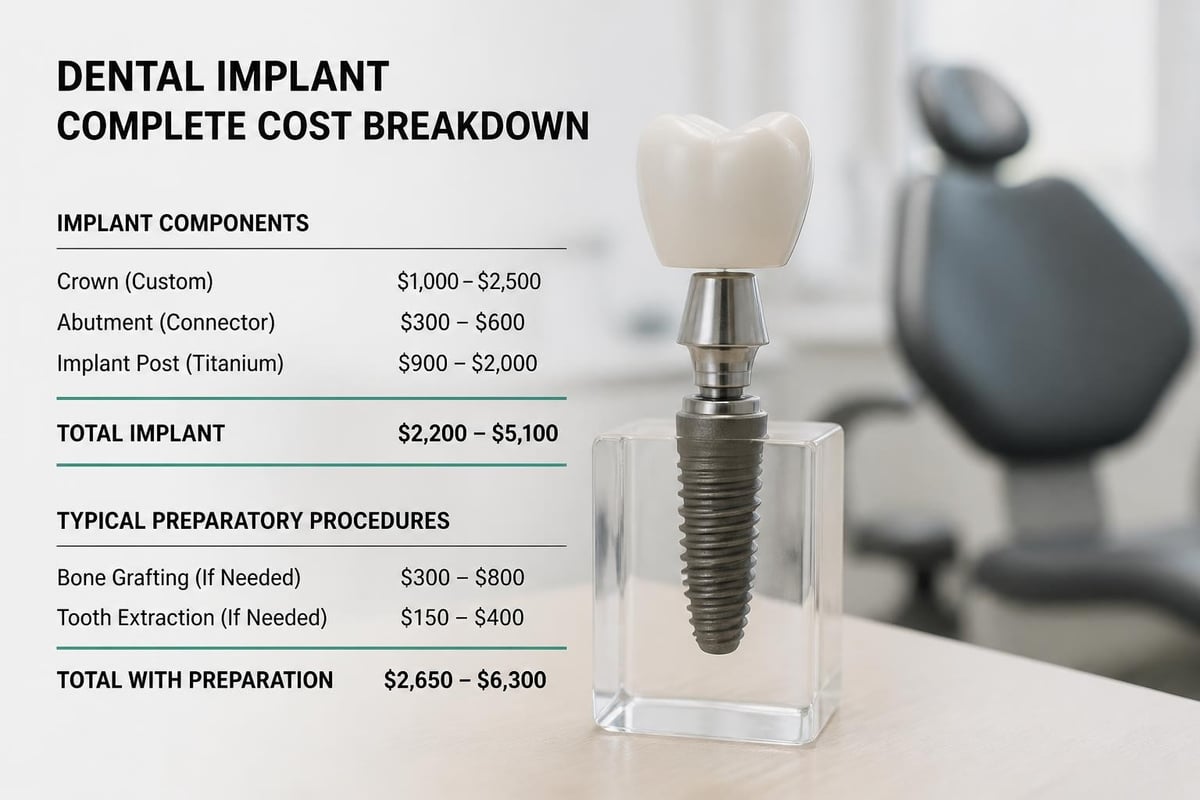
Every complete dental implant consists of three distinct parts, each with its own associated cost:
- Titanium post (implant fixture): The surgical component placed into your jawbone, typically ranging from $1,500 to $2,500
- Abutment: The connecting piece between the post and crown, usually costing $300 to $500
- Crown: The visible tooth restoration, ranging from $1,000 to $3,000
Without any insurance coverage, a single dental implant can cost between $3,000 and $6,000 in Texas, with the national average hovering around $4,500 per tooth.
Additional Procedures That Impact Total Cost
Many patients require preparatory treatments before implant placement, which add to the overall investment:
| Procedure | Average Cost | Purpose |
|---|---|---|
| Bone grafting | $300-$3,000 | Builds jawbone density |
| Sinus lift | $1,500-$2,500 | Creates space in upper jaw |
| Tooth extraction | $150-$650 | Removes damaged tooth |
| CT scan/imaging | $300-$600 | Treatment planning |
These supplementary procedures can significantly influence the dental implant cost with insurance vs without insurance, depending on what your specific plan covers.
How Dental Insurance Typically Covers Implants
Most traditional dental insurance plans were designed decades ago when implants were considered experimental, which explains why coverage remains limited even in 2026.
Standard Coverage Percentages
Dental insurance operates on a tiered coverage system:
- Preventive care: 100% coverage (cleanings, exams)
- Basic procedures: 70-80% coverage (fillings, extractions)
- Major procedures: 50% coverage (crowns, bridges, implants)
When implants are covered, they typically fall into the major procedures category at 50% reimbursement, but this only applies after you've met your annual deductible.
Annual Maximum Limitations
The biggest limitation affecting dental implant cost with insurance vs without insurance is the annual maximum benefit. According to research on dental insurance coverage patterns, most plans cap annual benefits at $1,000 to $2,000, regardless of your actual treatment costs.
Here's a realistic example: If your plan covers implants at 50% with a $1,500 annual maximum, and your implant costs $4,500, your insurance would theoretically pay $2,250. However, you'd only receive $1,500 due to the annual cap, leaving you responsible for $3,000 out-of-pocket.
Missing Tooth Clause Complications
Many insurance policies include a missing tooth clause that denies coverage for replacing teeth lost before your coverage began. This clause can completely eliminate implant benefits for teeth you lost years ago, making the comparison of dental implant cost with insurance vs without insurance irrelevant for some patients.
If you're exploring whether dental implants or bridges are right for you, understanding these coverage limitations helps inform your decision.
Real Cost Scenarios: Insurance vs No Insurance
Let's examine specific situations Texas patients face when comparing costs.
Scenario 1: Single Tooth Replacement With PPO Insurance
Total treatment cost: $4,800 (including all components and imaging)
With insurance coverage:
- Annual deductible: $50
- Insurance pays 50% after deductible: $2,375 (but capped at $1,500 maximum)
- Patient pays: $3,300
Without insurance:
- Full retail price: $4,800
- Cash discount (15% typical): $720
- Patient pays: $4,080
Savings with insurance: $780
Scenario 2: Multiple Implants Spanning Two Calendar Years
Patients requiring multiple implants can strategically schedule treatments across two benefit periods to maximize coverage.
- Implant #1 in December 2026: Insurance pays $1,500 of $4,500
- Implant #2 in January 2027: Insurance pays another $1,500 of $4,500
- Total insurance contribution: $3,000
- Total patient cost: $6,000 (instead of $9,000 without strategic timing)
This approach demonstrates how understanding your benefits can significantly reduce the dental implant cost with insurance vs without insurance gap.
Scenario 3: No Insurance Coverage Available
For patients whose plans don't cover implants or who lack dental insurance entirely, the financial picture looks different. According to detailed breakdowns of implant costs without insurance, out-of-pocket patients typically pay between $3,500 and $6,500 per tooth in Texas.

When Medical Insurance May Cover Dental Implants
While dental insurance coverage remains limited, certain medical insurance policies may provide benefits under specific circumstances.
Qualifying Medical Conditions
Medical necessity can sometimes trigger coverage where dental plans fall short. Health insurance may cover dental implants when tooth loss results from:
- Accidental trauma: Car accidents, sports injuries, or workplace incidents
- Cancer treatment: Radiation or chemotherapy affecting oral structures
- Congenital conditions: Cleft palate or ectodermal dysplasia
- Surgical reconstruction: Tumor removal requiring jaw reconstruction
Documentation from medical providers proving the necessity becomes critical in these cases. The difference between dental implant cost with insurance vs without insurance can be dramatic when medical coverage applies, as medical plans typically have higher annual maximums ($5,000 to unlimited) compared to dental plans.
Filing Medical Claims Successfully
Obtaining medical insurance approval requires:
- Pre-authorization from your medical insurance carrier
- Detailed treatment plans from both your dentist and physician
- Medical documentation linking tooth loss to a covered condition
- Procedure coding using medical codes (CPT) rather than dental codes (CDT)
- Persistence through potential initial denials and appeals
In-Network vs Out-of-Network Provider Impact
Your choice of dental provider dramatically affects your final costs, regardless of insurance status.
Network Negotiated Fees
In-network providers at facilities like Dental Plus Clinic locations throughout Texas have pre-negotiated fees with insurance companies that are typically 15-30% lower than standard retail prices. Research on dental insurance plans covering implants shows these negotiated rates can save patients hundreds to thousands of dollars.
| Provider Type | Average Single Implant Cost | Insurance Reimbursement | Patient Responsibility |
|---|---|---|---|
| In-network PPO | $3,800 | $1,500 | $2,300 |
| Out-of-network | $5,200 | $1,500 | $3,700 |
| Cash patient (no insurance) | $4,500 | $0 | $4,500 |
Understanding UCR Fees
Out-of-network providers can charge their standard fees, but insurance only reimburses based on "Usual, Customary, and Reasonable" (UCR) rates for your geographic area. If your dentist charges $5,500 but the UCR is $4,000, your 50% coverage calculates from $4,000 ($2,000), not the actual charge, leaving you with a $3,500 bill instead of $2,750.
Staying in-network typically provides the most predictable costs when comparing dental implant cost with insurance vs without insurance scenarios.
Alternative Financing and Savings Options
Beyond traditional insurance, multiple strategies help manage implant costs.
Dental Savings Plans
These membership programs offer an alternative to insurance, providing:
- 10-60% discounts on dental procedures
- No annual maximums or claim forms
- No waiting periods for major procedures
- Monthly or annual membership fees ($100-$350 per year)
For patients whose insurance doesn't cover implants, dental savings plans can reduce costs comparable to insurance benefits without the coverage restrictions.
Payment Plans and Financing
Most dental practices, including Dental Plus Clinic, offer flexible payment options:
- In-house payment plans: Interest-free installments over 6-12 months
- Third-party financing: Companies like CareCredit offer promotional periods (0% interest for 12-24 months)
- Credit cards: Healthcare-specific cards with deferred interest
- Health Savings Accounts (HSA): Pre-tax dollars reduce effective cost by your tax rate
These options make the dental implant cost with insurance vs without insurance comparison less critical for patients who can manage monthly payments rather than lump-sum expenses.
Timing Strategies for Maximum Benefits
Smart scheduling maximizes your insurance dollars:
- Complete preliminary work in one benefit year: Extractions, bone grafts
- Place implant posts in the next year: New annual maximum applies
- Add crowns in a third year if needed: Spreads costs across multiple periods
This strategy essentially triples your available insurance benefits from $1,500 to $4,500 over three years for complex cases.
Factors That Influence Individual Implant Costs
Beyond insurance coverage, several variables affect what you'll actually pay.
Geographic Location Variations
Dental costs vary significantly across Texas regions. Urban areas like Austin and San Antonio typically charge 15-25% more than smaller cities. Our Leander location offers competitive pricing while maintaining the same quality standards across all facilities.
Material and Technology Choices
Advances in dental implant technology affect pricing:
- Standard titanium implants: Industry standard, well-researched, moderate cost
- Zirconia implants: Metal-free option, 20-30% premium
- Guided surgery with 3D planning: Increased precision, adds $500-$1,500
- Immediate load implants: Same-day temporary teeth, may increase costs
Understanding these options helps when reviewing the latest dental implant technology and making cost-effective choices.
Provider Experience and Expertise
Highly experienced implant specialists may charge premium fees, but their expertise often results in:
- Fewer complications requiring corrective procedures
- Higher success rates (98% vs 95% for less experienced providers)
- Shorter treatment timelines
- Better long-term outcomes
Learning how to find the best implant dentist balances cost considerations with quality care.
Full Mouth Restoration Costs and Coverage
Patients needing multiple implants face different financial considerations.
All-on-4 and All-on-6 Procedures
These techniques replace entire arches using fewer implants:
- All-on-4: Four implants per arch, $15,000-$30,000 per arch
- All-on-6: Six implants per arch, $20,000-$35,000 per arch
- Full mouth (both arches): $30,000-$70,000 total
Insurance rarely covers these extensive procedures at meaningful levels. With a $1,500 annual maximum, coverage might represent only 2-5% of total costs, making the dental implant cost with insurance vs without insurance difference negligible for full-mouth cases.
Understanding the differences between All-on-4 vs All-on-6 dental implants helps patients make informed decisions about these significant investments.
Alternative Full Arch Options
Cost-conscious patients should consider:
| Option | Cost Range | Durability | Insurance Coverage |
|---|---|---|---|
| Traditional dentures | $1,500-$3,000 | 5-8 years | Often 50% |
| Implant-supported dentures | $8,000-$15,000 | 10-15 years | Limited |
| All-on-4/6 | $15,000-$35,000 | 20+ years | Minimal |
| Individual implants (full arch) | $30,000-$60,000 | 25+ years | Limited |
Tax Deductions and FSA/HSA Benefits
Financial benefits extend beyond insurance coverage.
Medical Expense Deductions
Dental implants qualify as deductible medical expenses if you itemize deductions. When your total medical expenses exceed 7.5% of your adjusted gross income, you can deduct the excess. For a family earning $80,000 annually, medical expenses beyond $6,000 become deductible.
Example: $15,000 in dental implants plus $3,000 in other medical costs = $18,000 total. Minus $6,000 threshold = $12,000 deductible amount. At a 22% tax bracket, this saves $2,640 in federal taxes.
Pre-Tax Account Advantages
Using FSA or HSA funds provides immediate tax savings:
- Flexible Spending Account (FSA): Reduce taxable income, "use it or lose it" annually
- Health Savings Account (HSA): Reduce taxable income, funds roll over indefinitely, triple tax advantage
Paying $4,500 from an HSA in a 22% tax bracket saves approximately $990 in taxes, effectively reducing your cost to $3,510.
Common Questions About Implant Insurance Coverage
Why Don't All Dental Plans Cover Implants?
Insurance companies often classify implants as cosmetic or elective procedures despite their functional benefits. This classification dates back to when implants were new technology. Many policies written today still carry these outdated limitations, though coverage is slowly improving as implants become the standard of care.
Can I Upgrade My Insurance for Better Implant Coverage?
Switching to a plan with implant coverage is possible but requires careful consideration:
- Waiting periods: Most plans impose 6-12 month waiting periods for major procedures
- Premium increases: Better coverage typically costs $30-$80 more monthly
- Break-even analysis: Calculate whether premium increases over the waiting period exceed potential benefits
In many cases, the additional premiums paid during waiting periods nearly equal the additional coverage received, making upgrades financially neutral unless you need multiple implants.
Do Discount Dental Plans Work Better Than Insurance?
For implant-specific needs, discount plans sometimes provide better value. According to comprehensive analyses of implant costs, discount plans offering 20-40% savings without annual maximums can save more than traditional insurance for patients needing multiple implants or expensive procedures.
What Documentation Do I Need for Insurance Claims?
Successful claims require:
- Pre-treatment X-rays and CT scans showing bone structure
- Detailed treatment plan with procedure codes (D6010 for surgical placement, D6056-D6067 for abutments, D6058-D6094 for crowns)
- Clinical notes documenting medical necessity
- Pre-authorization approval (when required)
- Itemized invoices showing dates of service
Working with experienced staff who understand insurance procedures increases approval rates significantly.
How Long Does Insurance Processing Take?
Timeline expectations:
- Pre-authorization: 2-4 weeks for initial review
- Treatment completion: Varies by procedure complexity
- Claim submission: Within 30 days of service
- Processing: 30-60 days for payment
- Appeals (if denied): Additional 30-90 days
Planning for these timelines helps manage cash flow, especially when coordinating treatment across multiple benefit years to optimize the dental implant cost with insurance vs without insurance equation.
Making the Financial Decision: Is Insurance Worth It?
Evaluating whether insurance coverage justifies the investment requires personal analysis.
Cost-Benefit Analysis Framework
Consider this decision matrix:
If you need one implant:
- Insurance benefit: ~$1,500 (after $1,200 annual premiums)
- Net benefit: $300
- Verdict: Marginal value unless you need other dental work
If you need three implants over two years:
- Insurance benefit: ~$3,000 (after $2,400 in premiums)
- Net benefit: $600
- Verdict: Moderate value with strategic timing
If you have existing insurance through employment:
- Additional cost: Often minimal or employer-paid
- Verdict: Maximize benefits since you're already paying
When Self-Pay Makes More Sense
Paying without insurance becomes attractive when:
- Your employer doesn't offer dental benefits, making individual plans expensive
- You need treatment immediately and can't wait through waiting periods
- The practice offers significant cash discounts (15-25%)
- You have access to 0% financing for 12-24 months
- Your insurance has a missing tooth clause excluding coverage
Many patients find that combining cash discounts with payment plans produces similar net costs to using insurance without the administrative complexity.
What Texas Patients Should Know
State-specific factors influence costs for families across Texas.
Regional Cost Variations
Average single implant costs by Texas region:
- Major metros (Houston, Dallas, Austin): $4,500-$6,000
- Mid-size cities (San Antonio, New Braunfels, Leander): $3,800-$5,200
- Smaller communities (Beeville, Seguin, Converse): $3,500-$4,800
Dental Plus Clinic maintains consistent, transparent pricing across all five Texas locations, ensuring Beeville patients receive the same quality and value as those in Leander.
Texas Medicaid and CHIP Coverage
Adult Medicaid in Texas provides extremely limited dental coverage, typically only emergency extractions. Implants are not covered under standard Medicaid. CHIP (Children's Health Insurance Program) covers comprehensive dental care for children but doesn't include implants since they're rarely needed in pediatric populations.
State Regulations Affecting Costs
Texas doesn't restrict dental fees through state price controls, allowing market competition to influence pricing. However, Texas does regulate:
- Mandatory pre-treatment cost estimates for procedures over $100
- Clear disclosure of insurance participation status
- Written treatment plans before major procedures
These protections help patients understand the dental implant cost with insurance vs without insurance before committing to treatment.
Steps to Take Before Getting Dental Implants
Preparation maximizes your financial and clinical outcomes.
Review Your Insurance Policy Thoroughly
Before scheduling consultations:
- Request your Summary Plan Description (SPD): Complete benefits document
- Confirm annual maximum and deductible: Current year usage
- Verify waiting periods: When you're eligible for major procedures
- Check missing tooth clauses: Pre-existing condition limitations
- Identify in-network providers: Maximum benefit availability
Get Multiple Treatment Estimates
Consulting several providers reveals cost variations and treatment approaches. Request itemized estimates showing:
- Examination and diagnostic imaging fees
- Surgical placement costs
- Abutment and crown expenses
- Any necessary preparatory procedures
- Timeline for multi-stage treatments
Comparing these details helps identify the best value while ensuring quality care from providers like those meeting strict clinical standards.
Explore All Payment Options
Before treatment begins:
- Apply for healthcare credit cards to secure promotional financing
- Verify HSA/FSA available balances
- Discuss in-house payment plans with your provider
- Consider dental savings plans if insurance coverage is minimal
- Research whether medical insurance might apply to your situation
Create a Multi-Year Treatment Plan
For complex cases requiring multiple implants, strategic scheduling maximizes benefits:
Year 1 (2026): Extractions, bone grafting, initial diagnostics
Year 2 (2027): Implant post placement
Year 3 (2028): Final crown restorations
This approach utilizes three years of insurance benefits ($4,500 total) instead of one year ($1,500), dramatically improving the dental implant cost with insurance vs without insurance comparison.
Long-Term Value Beyond Initial Costs
While upfront costs dominate initial decisions, long-term value matters significantly.
Lifetime Cost Comparison
Over 25 years, consider total ownership costs:
| Solution | Initial Cost | Replacements | Total 25-Year Cost |
|---|---|---|---|
| Dental implant | $4,500 | None expected | $4,500 |
| Bridge | $3,000 | 1-2 replacements | $6,000-$9,000 |
| Partial denture | $1,500 | 3-4 replacements | $6,000-$7,500 |
Implants often prove most economical over extended periods despite higher initial investments. Understanding detailed implant procedure steps clarifies why this longevity justifies the cost.
Health and Quality of Life Benefits
Beyond financial calculations, implants provide:
- Bone preservation: Prevents jaw deterioration that occurs with missing teeth
- Adjacent tooth protection: No grinding down healthy teeth like bridges require
- Confidence restoration: Natural appearance and function
- Nutritional benefits: Ability to eat all foods without restriction
- Speech clarity: Stable teeth don't slip like dentures
These intangible benefits have real value that pure cost comparisons don't capture.
Taking Action on Your Implant Journey
Armed with comprehensive cost information, you're ready to move forward.
Schedule Consultations With Confidence
When meeting with dental providers:
- Bring your insurance card and plan information
- Ask specific questions about fees, payment plans, and insurance processing
- Request pre-authorization submission before committing
- Discuss alternative treatment timelines that maximize coverage
- Evaluate the provider's experience, technology, and patient reviews
Don't Let Cost Prevent Necessary Treatment
While financial planning matters, avoiding necessary dental treatment due to cost concerns often leads to:
- More complex problems requiring more expensive solutions
- Bone loss making future implant placement difficult or impossible
- Shifting teeth creating bite problems and additional dental issues
- Diminished quality of life from missing teeth
Most practices, including Dental Plus Clinic, work with patients to create affordable treatment plans that balance clinical needs with budget realities. Understanding the complete picture of dental implant cost with insurance vs without insurance empowers you to make decisions based on value rather than solely on price.
Stay Informed About Coverage Changes
Dental insurance continues evolving, with more plans recognizing implants as standard care:
- Review your benefits annually during open enrollment
- Consider upgrading coverage if your employer offers premium plans
- Monitor industry trends toward improved implant coverage
- Advocate with your employer's benefits administrator for better dental options
The gap between dental implant cost with insurance vs without insurance may narrow in coming years as insurers recognize the long-term cost savings from durable, permanent solutions.
Understanding the complete financial landscape of dental implants helps you make confident decisions about your oral health investments. Whether you have comprehensive insurance coverage, minimal benefits, or no insurance at all, affordable pathways exist to restore your smile with permanent, functional solutions. Dental Plus Clinic offers transparent pricing, flexible payment options, and expert care across five convenient Texas locations, helping families throughout Beeville, Seguin, New Braunfels, Leander, and Converse achieve healthy, confident smiles regardless of their insurance situation. Contact us today for a personalized consultation and cost estimate tailored to your specific needs and coverage.