
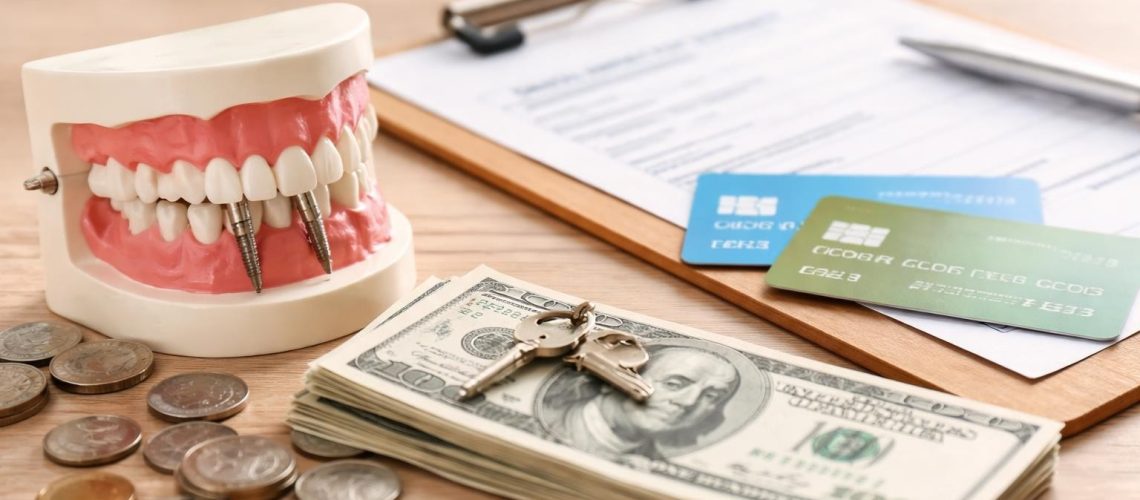
Dental implants represent a significant investment in oral health and quality of life, with costs ranging from $3,000 to $6,000 per tooth in Texas. While this advanced tooth replacement option offers unmatched durability and natural appearance, the upfront expense can feel overwhelming for many patients. Fortunately, a comprehensive range of dental implant financing options in Texas makes this transformative treatment accessible to more people than ever before. From specialized healthcare credit cards to flexible payment plans and dental savings programs, Texas residents have multiple pathways to achieve the smile they deserve without compromising their financial stability.
Understanding Dental Implant Costs in Texas
The total investment for dental implants varies significantly based on several factors unique to each patient’s situation. Single tooth replacements typically start around $3,000, while full-arch restorations can exceed $30,000.
Breaking Down the Investment
Treatment complexity, implant materials, and geographic location within Texas all influence final costs. Urban centers like Austin and Houston may charge slightly higher fees compared to smaller communities, though quality of care remains excellent across the state. According to the comprehensive cost guide for 2026, Texas pricing aligns with national averages while offering competitive options through experienced providers.
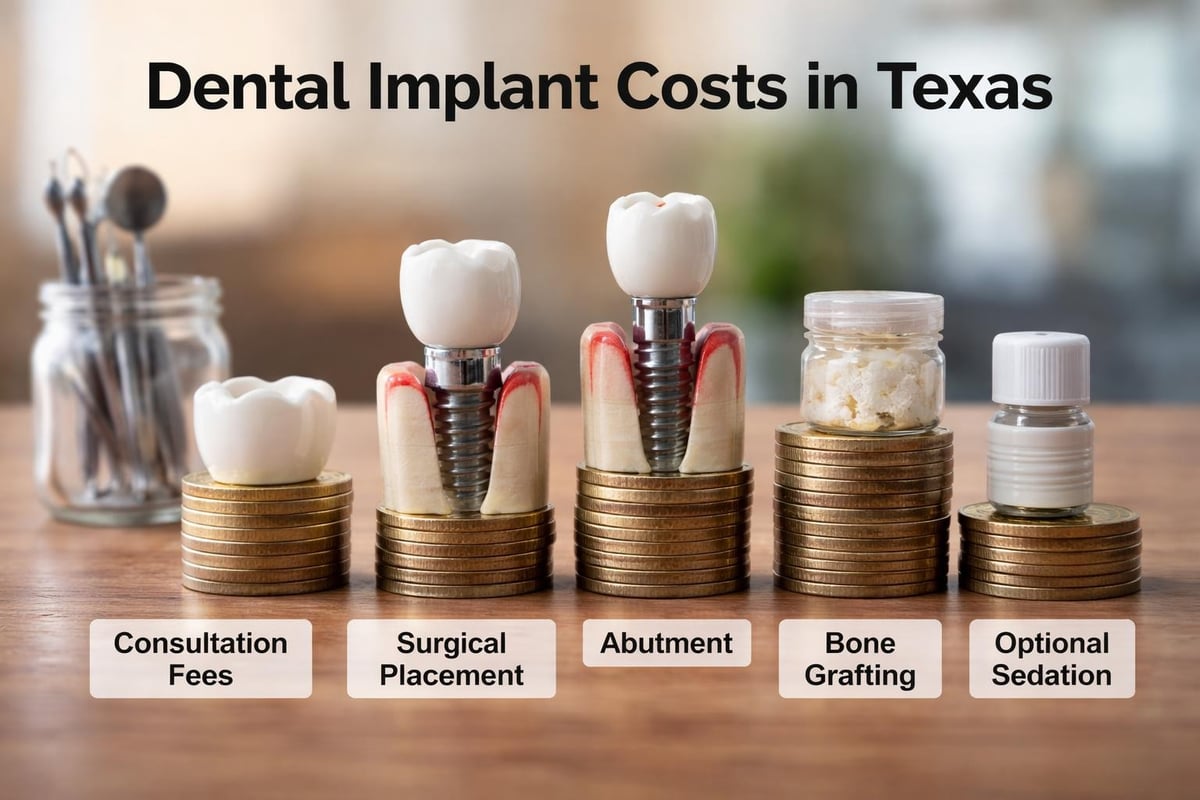
Key cost components include:
- Initial consultation and diagnostic imaging
- Surgical implant placement
- Abutment attachment
- Custom crown fabrication
- Potential bone grafting procedures
The complete dental implant procedure involves multiple stages, each contributing to the overall investment. Patients requiring bone grafts or sinus lifts will see higher costs, as these preparatory procedures ensure long-term implant success.
Healthcare Credit Cards for Dental Procedures
Healthcare-specific credit cards have emerged as one of the most popular dental implant financing options in Texas, offering flexibility and promotional benefits that traditional credit cards cannot match.
CareCredit: The Industry Standard
CareCredit’s dental financing program has helped millions of patients access necessary dental treatments. This healthcare credit card provides promotional financing periods ranging from six to 24 months, during which no interest accrues if the balance is paid in full.
Application approval happens within minutes, and patients can use their credit line immediately for dental implants and related procedures. The card works at thousands of dental practices across Texas, including multiple locations that specialize in implant dentistry.
CareCredit advantages:
- Deferred interest promotional periods
- Immediate approval decisions
- Reusable credit line for future treatments
- Acceptance at numerous Texas dental offices
- Online account management tools
Alternative Healthcare Financing Providers
Beyond CareCredit, several other specialized lenders serve the dental market. Alphaeon Credit focuses exclusively on healthcare and aesthetic procedures, offering similar promotional periods with competitive terms. Their application process emphasizes accessibility, with approval options for various credit profiles.
Cherry financing has gained popularity for its transparent approach to dental procedure financing. The platform features no hidden fees, straightforward monthly payments, and a digital application that takes minutes to complete. Patients appreciate Cherry’s clear communication about interest rates and payment schedules before committing.
| Provider | Promotional Period | Application Time | Credit Limit Range |
|---|---|---|---|
| CareCredit | 6-24 months | 5 minutes | $1,000-$25,000 |
| Alphaeon Credit | 6-18 months | 3 minutes | $500-$30,000 |
| Cherry | Varies by plan | 2 minutes | $500-$15,000 |
| Sunbit | 3-24 months | 1 minute | $500-$10,000 |
Personal Loans for Dental Treatments
Traditional personal loans offer another viable path for financing dental implants, particularly for patients who prefer fixed interest rates and predictable payment schedules.
Banking Institutions and Credit Unions
Texas residents have access to competitive personal loan products through local credit unions and national banks. These loans typically feature fixed interest rates between 6% and 36%, depending on creditworthiness and loan terms.
LendingClub’s dental financing options provide fixed-rate loans specifically designed for medical and dental procedures. Borrowers receive funds quickly and enjoy the certainty of consistent monthly payments throughout the loan term. Unlike revolving credit lines, these installment loans have definitive payoff dates.
Credit unions often provide the most favorable terms for members with established relationships. Texas-based credit unions frequently offer special medical and dental loan programs with reduced rates and flexible qualification criteria.
Specialized Medical Lending Platforms
Proceed Finance specializes in patient financing for dental procedures, offering loans up to $70,000 with no collateral requirements. This higher lending limit accommodates extensive treatments like full-mouth reconstructions or multiple implant placements. The platform evaluates applications holistically, considering factors beyond traditional credit scores.
Personal loan benefits:
- Fixed monthly payments for budget planning
- No restrictions on dental provider choice
- Potential for lower interest rates than credit cards
- Loan terms extending up to seven years
- Funding available within days of approval
In-House Dental Office Payment Plans
Many Texas dental practices, recognizing that insurance coverage for implants remains limited, have developed internal financing solutions that eliminate third-party lenders entirely.
Direct Practice Financing
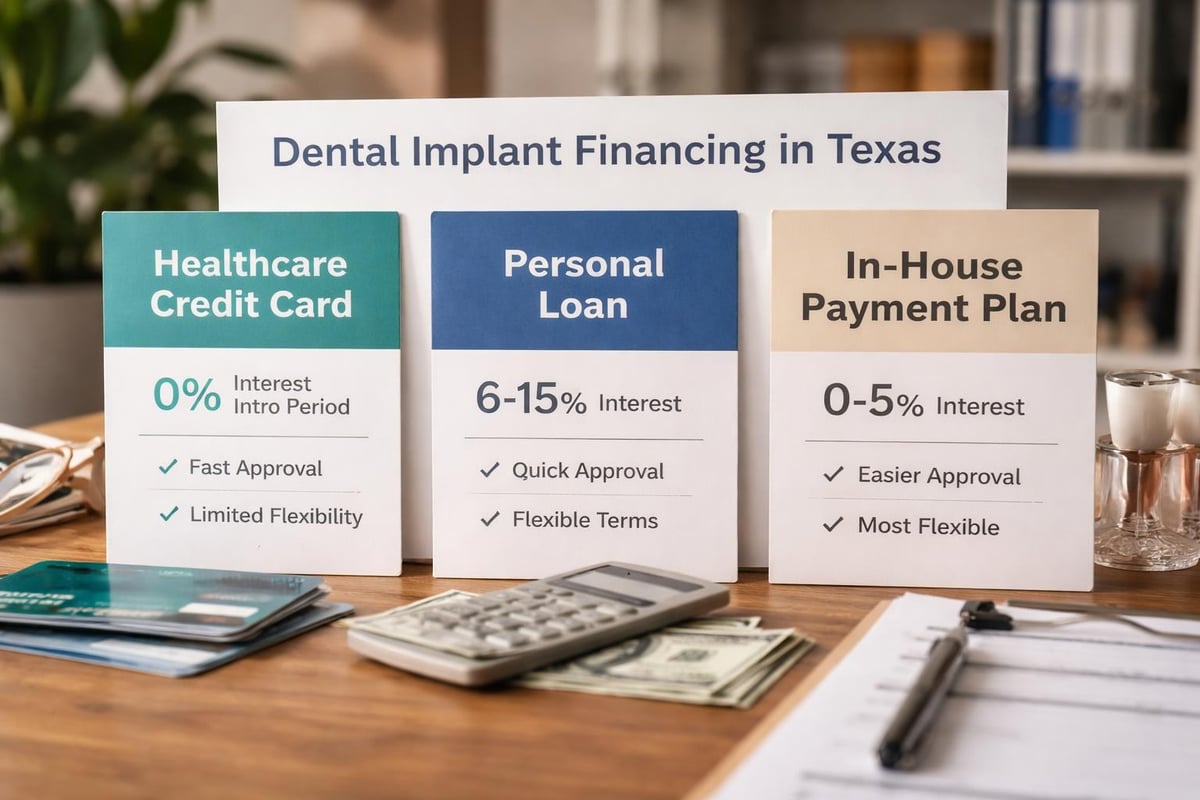
In-house payment plans allow patients to work directly with their dental provider to establish affordable monthly payments. These arrangements often feature zero or low interest, making them among the most economical dental implant financing options in Texas.
Practices structure these plans based on individual patient circumstances, considering treatment complexity, total costs, and financial capacity. Some offices require a down payment ranging from 10% to 30%, with remaining balances spread across six to 24 months.
The primary advantage lies in relationship-based flexibility. Dental teams can adjust payment schedules during unexpected financial challenges, maintaining treatment continuity while respecting patient situations. When exploring dental implants in Texas, asking about in-house financing should be among initial questions.
Membership and Savings Programs
Dental savings programs represent an innovative approach to reducing implant costs upfront. These annual membership plans, distinct from insurance, provide significant discounts on procedures including implants, crowns, and preventive care.
Programs typically cost $200 to $500 annually for individuals, with family plans available at higher rates. Members receive 15% to 40% reductions on dental services, potentially saving thousands on implant treatments. The savings plans available through participating practices often include additional benefits like complimentary exams and cleanings.
Savings program features:
- No waiting periods for major procedures
- No annual maximums or coverage limits
- Discounts apply to entire treatment plan
- Immediate activation upon enrollment
- Acceptance at multiple practice locations
Insurance Coverage Considerations
While traditional dental insurance typically provides minimal coverage for implants, understanding policy nuances helps maximize available benefits and reduce out-of-pocket expenses.
Navigating Dental Insurance Policies
Most dental insurance plans categorize implants as elective or cosmetic procedures, resulting in limited or zero coverage. However, certain components of implant treatment may qualify for partial reimbursement. Crown portions sometimes receive coverage under major services categories, particularly when replacing failed teeth due to trauma or disease.
Humana’s dental insurance plans offer various coverage tiers, with some premium options including implant benefits after waiting periods. Reviewing policy details carefully reveals potential coverage for preliminary procedures like extractions, bone grafts, or diagnostic imaging.
Maximizing insurance benefits:
- Schedule treatments across calendar years to utilize multiple annual maximums
- Submit pre-authorization requests for clear benefit expectations
- Coordinate benefits if covered under multiple policies
- Document medical necessity for improved approval odds
- Appeal denied claims with supporting clinical documentation
Medical Insurance Intersection
Certain circumstances allow medical insurance to contribute toward implant costs. When tooth loss results from accident, trauma, or medical conditions like cancer treatment, medical policies may cover portions of reconstruction. Congenital conditions affecting jaw development sometimes qualify for medical coverage as well.
Documentation proving medical necessity rather than cosmetic preference strengthens claims significantly. Working with dental offices experienced in medical insurance coordination streamlines this complex process.
Government Assistance and Charitable Programs
Texas residents facing financial hardship have additional resources for accessing necessary dental care, including implant treatments in qualifying situations.
Medicaid and State Programs
Texas Medicaid provides limited adult dental coverage, primarily focusing on emergency services. However, specific populations including pregnant women and individuals with certain disabilities may qualify for expanded benefits. While implants rarely receive approval, exploring eligibility remains worthwhile for comprehensive dental needs.
Some federally qualified health centers across Texas offer sliding fee scales based on income, making advanced dental treatments more accessible to low-income families. These community health centers prioritize functional restoration when tooth loss impacts nutrition, speech, or overall health.
Nonprofit Organizations and Dental Schools
Charitable dental programs occasionally provide implant treatments to qualified recipients. Organizations like Mission of Mercy conduct periodic clinics offering free dental services, though implant availability varies by event and patient need.
Texas dental schools provide implant treatments at reduced costs, performed by advanced students under experienced faculty supervision. The University of Texas Health Science Center at San Antonio and Texas A&M College of Dentistry offer comprehensive implant programs with significant savings compared to private practice fees.
Considerations for school-based treatment:
- Extended treatment timelines due to educational component
- Rigorous patient screening and case selection
- High-quality care with academic oversight
- Savings of 30% to 50% off standard fees
- Ideal for patients with time flexibility
Point-of-Service Financing Solutions
Modern technology has introduced immediate financing options available directly at dental appointments, streamlining the approval and acceptance process.
Digital Lending Platforms
Sunbit’s financing solution exemplifies point-of-service lending, providing instant decisions through digital applications completed on tablets or smartphones. Patients learn their approval status within seconds, with no impact on credit scores during the initial inquiry stage.
These platforms integrate seamlessly with dental practice management systems, allowing treatment coordinators to present financing options during consultation appointments. Approved patients leave with clear payment plans and scheduled treatment dates, eliminating financial uncertainty that often delays necessary care.
The speed and convenience of point-of-service financing make it particularly valuable for patients requiring immediate implant placement following emergency tooth extraction. When comparing various dental implant financing options in Texas, the instant nature of these solutions provides distinct advantages for time-sensitive situations.
Multi-Lender Comparison Tools
Some dental practices partner with platforms that simultaneously check multiple lenders, presenting patients with several offers for comparison. This approach ensures access to the most favorable terms available based on individual credit profiles and treatment costs.
Patients review different interest rates, monthly payments, and loan terms side-by-side, making informed decisions aligned with their financial preferences. The competitive nature of multi-lender platforms often results in better rates than single-source applications.

Tax Benefits and Health Savings Accounts
Strategic use of tax-advantaged accounts significantly reduces the effective cost of dental implants, representing an often-overlooked financing strategy.
Health Savings Accounts (HSAs)
Individuals enrolled in high-deductible health plans can contribute to HSAs, using pre-tax dollars for qualified medical expenses including dental implants. The triple tax advantage includes tax-deductible contributions, tax-free growth, and tax-free withdrawals for eligible expenses.
For 2026, HSA contribution limits reach $4,300 for individuals and $8,550 for families. Planning implant treatments around HSA funding allows patients to pay with pre-tax money, effectively reducing costs by their marginal tax rate.
HSA strategic considerations:
- Maximize annual contributions before treatment
- Coordinate with other financing for gaps
- Retain receipts for potential reimbursement timing flexibility
- Consider multi-year contribution strategies for expensive treatments
- Verify implant qualification under current IRS guidelines
Flexible Spending Accounts (FSAs)
FSAs operate similarly but require use-it-or-lose-it spending within the plan year. The 2026 contribution limit stands at $3,300 per individual. Employees planning implant procedures can increase FSA contributions during open enrollment, allocating pre-tax funds specifically for upcoming treatments.
Timing becomes crucial with FSAs due to annual forfeiture rules. Patients should schedule implant phases strategically to utilize full FSA balances while avoiding unused fund loss.
Medical Expense Tax Deductions
The IRS allows deductions for unreimbursed medical and dental expenses exceeding 7.5% of adjusted gross income. For patients with substantial dental costs, itemizing deductions may provide tax relief. Implants, along with related procedures like bone grafting, qualify as deductible medical expenses.
Maintaining detailed expense records, including payments made through financing programs, ensures accurate deduction claims. Combining multiple family members’ dental expenses in a single tax year may help reach the deduction threshold.
Comparing Financing Options: Making the Right Choice
Selecting among available dental implant financing options in Texas requires evaluating personal financial circumstances, treatment timelines, and long-term budget impacts.
Decision-Making Framework
Credit scores significantly influence available options and terms. Excellent credit (720+) unlocks the best promotional financing and lowest interest rates, while fair credit (620-719) still qualifies for numerous programs albeit with higher costs. Patients with challenged credit may find in-house payment plans or co-signer arrangements most accessible.
Treatment urgency also guides financing selection. Emergency implant needs following sudden tooth loss favor point-of-service solutions with immediate approval, while planned procedures allow time for HSA accumulation or savings program enrollment.
| Financing Type | Best For | Typical APR | Approval Time | Flexibility |
|---|---|---|---|---|
| Healthcare Credit Card | Quick approval needed | 0%-26.99% | Minutes | High |
| Personal Loan | Fixed payments preferred | 6%-36% | Days | Medium |
| In-House Plan | Zero interest priority | 0%-12% | Same day | High |
| HSA/FSA | Tax optimization | N/A | Enrollment period | Low |
| Dental Savings Plan | Multiple treatments | N/A | Immediate | Medium |
Calculating Total Cost of Borrowing
Understanding the true expense of financing requires examining total interest paid over loan terms, not just monthly payments. A $5,000 implant financed at 18% APR over 24 months costs approximately $5,985 total, adding nearly $1,000 to the procedure price.
Conversely, promotional zero-interest offers through healthcare credit cards result in zero additional costs when balances are cleared within promotional periods. This makes careful comparison essential when evaluating dental implant financing options in Texas.
Cost optimization strategies:
- Pay more than minimum payments to reduce interest
- Choose shortest affordable repayment terms
- Utilize promotional zero-interest periods fully
- Compare APRs across multiple lenders
- Consider down payments to reduce financed amounts
Location-Specific Financing Availability
Texas’s geographic diversity means financing availability and terms can vary between metropolitan areas and rural communities, though comprehensive options exist statewide.
Urban Versus Rural Access
Major cities like Houston, Dallas, Austin, and San Antonio offer the fullest range of financing providers and dental practices participating in multiple programs. Patients in these areas easily find offices accepting CareCredit, Cherry, Sunbit, and offering in-house plans simultaneously.
Smaller communities throughout Texas may have fewer participating providers, though quality care and financing remain accessible. Practices in cities like Seguin, Beeville, and Converse maintain robust financing partnerships to serve their patient populations effectively.
Multi-Location Practice Advantages
Dental groups with multiple Texas locations often negotiate preferred financing arrangements benefiting patients across all sites. Standardized payment options, transparent pricing, and established lender relationships create consistent experiences regardless of which office patients visit.
This consistency proves valuable for families with members receiving care at different locations or patients relocating within Texas during extended treatment periods.
Advanced Implant Treatments and Financing
Complex implant procedures like full-arch restorations require specialized financing approaches given their substantial investment levels.
Full-Mouth Reconstruction Financing
Treatments such as All-on-4 versus All-on-6 dental implants involve costs ranging from $20,000 to $50,000 per arch. Financing these transformative procedures often requires combining multiple payment strategies.
Patients might use healthcare credit cards for promotional financing up to credit limits, supplementing with personal loans for remaining balances. Others phase treatments across multiple benefit years, utilizing annual insurance maximums and FSA contributions each period.
Phased treatment financing example:
- Year one: Upper arch with insurance maximum and FSA funds
- Interim period: Lower arch deposit via savings plan discount
- Year two: Lower arch completion with healthcare credit card
- Repayment: Combined personal loan to consolidate balances
Bone Grafting and Preparatory Procedures
The bone grafting required for dental implants adds significant expense before implant placement begins. Some financing programs allow pre-approval for total anticipated costs, including preparatory work.
Comprehensive financing covering all treatment phases prevents reapplication stress and ensures budget consistency. Treatment coordinators experienced in complex case financing provide invaluable guidance through multi-stage planning.
Building Credit for Better Financing Terms
Patients anticipating future implant needs can take proactive steps to improve credit profiles, accessing better financing terms when treatment time arrives.
Credit Improvement Strategies
Simple actions like paying existing debts consistently, reducing credit utilization below 30%, and correcting credit report errors can raise scores significantly over six to twelve months. Even modest score increases from fair to good credit ranges unlock substantially better interest rates.
Becoming an authorized user on established accounts or securing credit-builder loans through credit unions also strengthens credit profiles. These preparations prove worthwhile when facing major dental investments.
Timing Treatment with Financial Readiness
Elective implant procedures offer flexibility in scheduling, allowing patients to optimize financial positioning. Delaying treatment several months to improve credit, accumulate savings, or maximize HSA contributions often reduces total costs more than the waiting period inconvenience.
However, this strategy applies only to stable situations. Progressive bone loss or adjacent tooth movement following tooth loss may complicate future implant placement, potentially increasing overall treatment complexity and expense. Consulting with dental professionals helps balance financial preparation against clinical timing considerations.
Insurance Verification and Pre-Authorization
Thorough insurance investigation before committing to financing ensures patients maximize available coverage and avoid unexpected costs.
The Verification Process
Reputable dental practices conduct comprehensive insurance verification, determining exact coverage for each treatment component. This process examines annual maximums, remaining benefits, waiting periods, and excluded services.
Pre-authorization requests submitted to insurance companies before treatment provide binding coverage determinations. While requiring additional time, pre-authorizations eliminate surprise denials after procedures complete. When evaluating dental implant financing options in Texas, factor insurance verification timelines into treatment planning.
Essential verification questions:
- What percentage does my plan cover for crowns and major services?
- Are dental implants specifically excluded or covered?
- Have I met my annual deductible?
- How much remains of my annual maximum benefit?
- Do coverage percentages increase in subsequent years?
Coordination of Benefits
Patients covered under multiple dental plans through employment, spouses, or other sources can coordinate benefits for maximum reimbursement. Primary insurance pays first according to plan terms, with secondary coverage potentially filling gaps.
This coordination sometimes covers significant portions of implant costs, particularly crown components. Experienced dental billing specialists navigate coordination complexities, ensuring patients receive all entitled benefits.
Evaluating Provider Financing Transparency
The dental practice’s approach to financial discussions significantly impacts the financing experience and overall satisfaction with care.
Red Flags and Green Flags
Transparent practices provide detailed cost breakdowns before treatment begins, clearly separating procedure fees, materials costs, and financing charges. They present multiple payment options without pressure, allowing patients time for informed decisions.
Warning signs include vague cost estimates, reluctance to provide written quotes, or aggressive financing promotion before treatment discussions. Quality-focused practices prioritize clinical appropriateness, introducing financing as a supportive tool rather than a sales tactic.
Indicators of financing transparency:
- Written treatment plans with itemized costs
- Multiple financing options presented equally
- Clear explanation of interest rates and terms
- No-pressure decision-making timelines
- Accessible financial coordinators for questions
Questions to Ask Your Dental Provider
Before committing to treatment and financing, patients should thoroughly understand all financial aspects. Asking direct questions about total costs, payment timing, financing partner relationships, and fee structures prevents misunderstandings.
Inquiring about potential additional costs if complications arise, revision policies, and warranty coverage demonstrates financial diligence. Reputable practices welcome these questions, viewing them as signs of engaged, informed patients.
Alternative Implant Solutions and Cost Considerations
Exploring different implant types and restoration approaches may reveal more affordable options while maintaining excellent functional outcomes.
Material and Design Variations
Traditional titanium implants represent the gold standard, though zirconia dental implants offer metal-free alternatives at sometimes different price points. Material selection impacts costs, healing times, and financing needs.
Mini implants, while not suitable for all situations, cost significantly less than standard diameter implants and often support dentures effectively. Discussing various technical approaches with dental professionals may identify budget-appropriate solutions without compromising results.
Bridge and Denture Comparisons
While implants provide superior outcomes, understanding alternatives helps patients make informed choices aligned with financial realities. Comparing dental implants versus dentures reveals different cost structures, with dentures requiring lower upfront investment but potential long-term replacement expenses.
Some patients initially choose partial dentures or bridges while accumulating funds for eventual implant treatment. Discussing interim solutions with dental teams prevents gaps in oral function while financial preparation continues.
Creating a Personal Financing Strategy
Successful implant financing requires personalized planning that accounts for individual circumstances, treatment complexity, and financial goals.
Step-by-Step Planning Process
Begin by obtaining detailed treatment plans with complete cost estimates from dental providers. Research financing options thoroughly, comparing terms across healthcare credit cards, personal loans, and in-house plans.
Calculate comfortable monthly payment amounts based on current budgets, avoiding overextension that creates financial stress. Remember that dental implant financing options in Texas should enhance life quality, not diminish it through excessive debt burden.
Planning checklist:
- Obtain comprehensive treatment cost estimate
- Review current credit score and reports
- Research minimum three financing options
- Calculate total interest costs for each option
- Determine realistic monthly payment capacity
- Check insurance coverage and FSA/HSA availability
- Schedule consultation with practice financial coordinator
- Compare offers and select best-fit solution
- Read all financing agreements thoroughly
- Establish automatic payments to avoid missed installments
Emergency Fund Maintenance
While financing makes implants accessible, maintaining emergency savings protects against financial disruption if income changes occur during repayment. Financial advisors recommend retaining three to six months of expenses in liquid savings even when financing major purchases.
Balancing implant investment with emergency fund preservation requires careful budgeting. Extending loan terms to reduce monthly payments, while increasing total interest costs, may prove worthwhile for maintaining financial security cushions.
Workplace Benefits and Dental Stipends
Some Texas employers offer supplemental benefits that reduce dental implant costs, though employees often overlook these valuable resources.
Employer-Sponsored Programs
Progressive companies provide dental care stipends, typically $500 to $2,000 annually, usable for any dental services including implants. These funds supplement traditional insurance, directly reducing out-of-pocket expenses.
Health reimbursement arrangements (HRAs) administered by employers sometimes cover dental procedures, particularly when documented as medically necessary. Reviewing employee benefits documentation or consulting HR departments reveals potential hidden assistance.
Professional Association Benefits
Membership in professional organizations, unions, or alumni associations occasionally includes dental discount programs or group purchasing arrangements. These benefits negotiate reduced fees with participating providers, lowering baseline costs before financing considerations.
The American Association of Retired Persons (AARP), for example, offers dental discount plans to members that may reduce implant expenses. Exploring all membership benefits across professional and personal affiliations uncovers potential savings opportunities.
Monitoring and Managing Ongoing Payments
Successfully financing dental implants extends beyond approval, requiring diligent payment management throughout repayment periods.
Payment Automation and Reminders
Enrolling in automatic payments from checking accounts prevents missed installments that trigger late fees and credit damage. Most lenders reduce interest rates by 0.25% to 0.50% for automatic payment enrollment, creating additional savings.
Digital calendar reminders before payment due dates provide backup notification systems. Monitoring account balances ensures sufficient funds exist, preventing overdraft situations that negate financing benefits.
Payment management best practices:
- Set up automatic payments immediately after approval
- Monitor account statements monthly for accuracy
- Pay extra toward principal when financially possible
- Maintain payment confirmations for record-keeping
- Contact lenders immediately if payment difficulties arise
Refinancing and Payoff Strategies
If financial situations improve during repayment, refinancing to lower rates reduces total interest costs. Personal loans can replace high-interest healthcare credit cards, particularly after promotional periods expire.
Accelerated payoff through additional principal payments shortens debt duration and decreases interest expense. Most dental financing carries no prepayment penalties, making early payoff beneficial when feasible.
Final Thoughts
Understanding the diverse dental implant financing options in Texas empowers patients to pursue the tooth replacement they deserve without financial overwhelm. By combining promotional healthcare credit, strategic use of tax-advantaged accounts, insurance benefits, and flexible payment plans, most Texas residents can access this life-changing treatment comfortably.
Whether you’re exploring implant solutions at Dental Plus Clinic in Beeville, Seguin, New Braunfels, Leander, or Converse, our financial coordinators stand ready to guide you through available financing programs tailored to your unique situation. With comprehensive treatment planning, transparent pricing, and partnerships with leading healthcare lenders, we’re committed to making your journey to a complete, confident smile both clinically excellent and financially manageable.