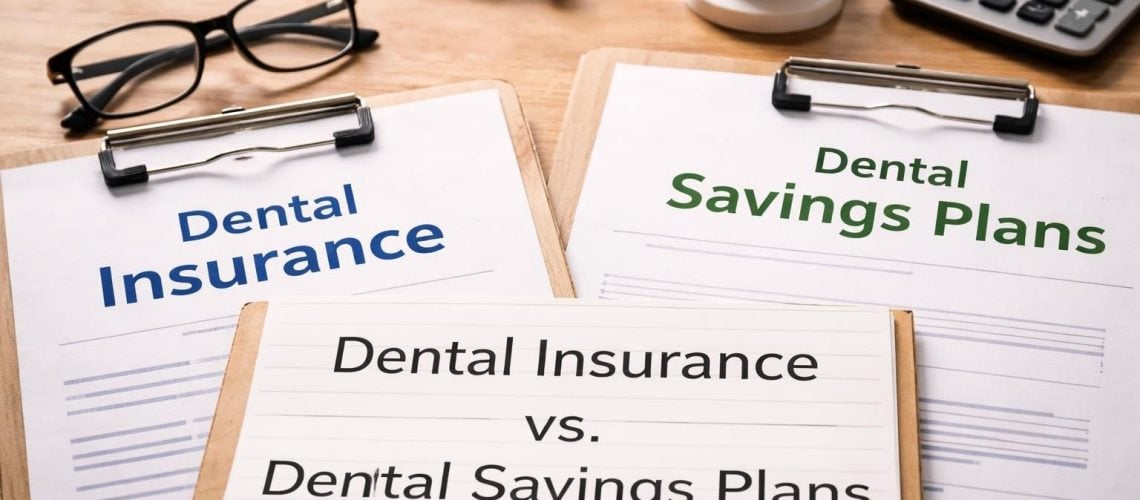
Choosing the right payment method for dental care represents a significant decision that impacts both your oral health and financial wellbeing. When examining dental insurance vs dental savings plans, patients across Texas face different coverage structures, cost models, and accessibility options that determine how they pay for routine cleanings, emergency procedures, and advanced treatments. Understanding these fundamental differences helps individuals and families make informed choices about which payment approach aligns with their specific dental needs, budget constraints, and treatment frequency. This comprehensive guide explores both options in depth, providing the clarity needed to select the most cost-effective solution for maintaining healthy smiles throughout 2026 and beyond.
Understanding Traditional Dental Insurance Coverage
Traditional dental insurance operates on a premium-based model where policyholders pay monthly fees in exchange for coverage across various dental procedures. These plans typically categorize treatments into preventive, basic, and major services, with each category carrying different coverage percentages and out-of-pocket costs.
Most dental insurance policies follow a standard structure where preventive care receives 100% coverage, basic procedures receive 70-80% coverage, and major treatments receive 50% coverage. This tiered system means patients still pay significant portions of their dental bills, particularly for advanced procedures like crowns, bridges, or implants.
How Dental Insurance Premiums and Deductibles Work
Insurance plans require monthly premium payments regardless of whether you visit the dentist. These premiums range from $20 to $50 per month for individual coverage and $50 to $150 for family plans, depending on the coverage level and provider.
Key cost components include:
- Monthly premiums paid to maintain coverage
- Annual deductibles ranging from $50 to $150 per person
- Copayments for specific procedures
- Coinsurance percentages for basic and major services
- Annual maximum benefits typically capped at $1,000 to $2,000
Deductibles must be satisfied before insurance coverage activates for most procedures, though preventive services usually bypass this requirement. Once the deductible is met, patients pay their coinsurance percentage until reaching the annual maximum, after which they assume full responsibility for additional costs.
Waiting Periods and Coverage Limitations
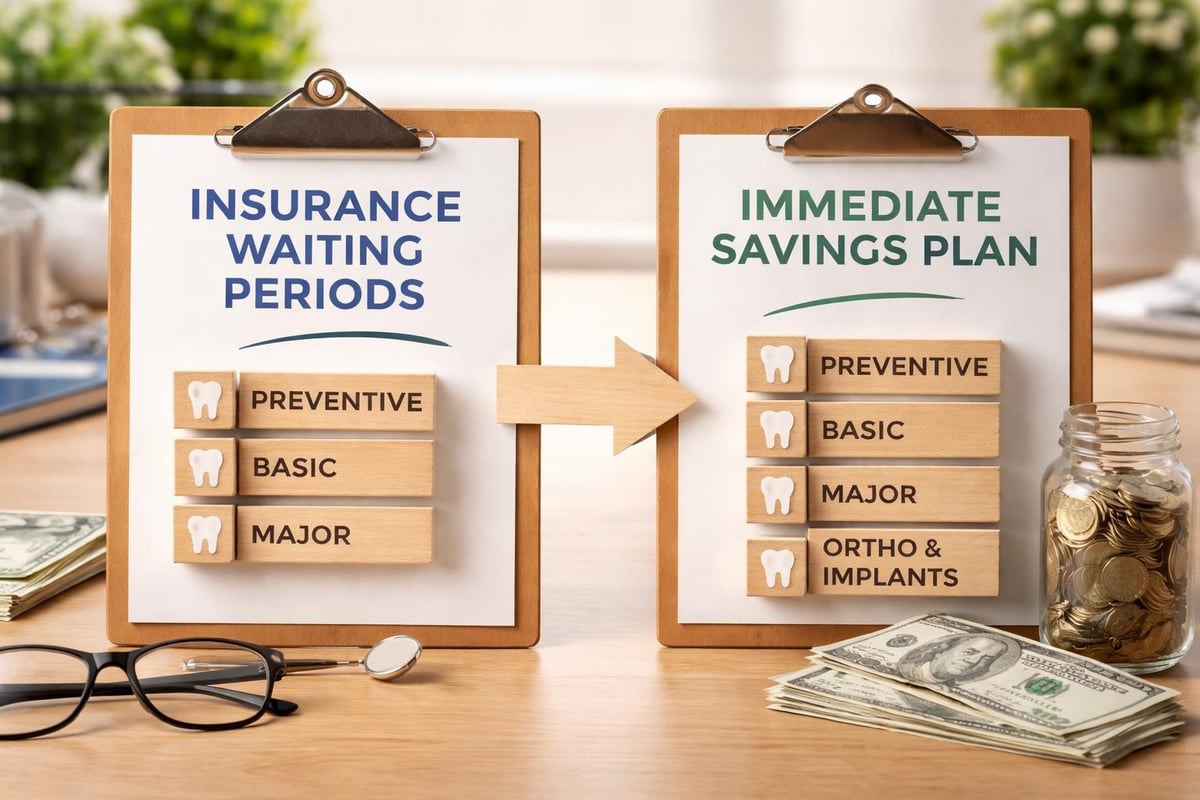
One significant drawback of dental insurance involves waiting periods that delay access to certain services. New policyholders often encounter waiting periods of three to six months for basic procedures and 12 months for major treatments.
These restrictions mean patients requiring immediate dental work may find insurance inadequate for their current needs. Understanding dental insurance limitations helps set realistic expectations about coverage availability and timing.
| Coverage Type | Typical Waiting Period | Coverage Percentage | Example Procedures |
|---|---|---|---|
| Preventive | None | 100% | Cleanings, exams, X-rays |
| Basic | 3-6 months | 70-80% | Fillings, extractions |
| Major | 6-12 months | 50% | Crowns, bridges, implants |
Exploring Dental Savings Plans as an Alternative
Dental savings plans, also called dental discount plans, operate fundamentally differently from insurance by offering membership-based discounts rather than coverage percentages. Members pay an annual fee ranging from $100 to $200 and receive pre-negotiated discounts of 10% to 60% on dental procedures at participating providers.
Unlike insurance, these plans impose no deductibles, no annual maximums, no claim forms, and no waiting periods for most services. This straightforward structure appeals to individuals seeking immediate access to affordable dental care without navigating complex insurance requirements.
How Membership-Based Discount Plans Function
When you join a dental savings plan, you gain access to a network of participating dentists who agree to provide services at reduced rates. The savings apply immediately upon enrollment, making these plans particularly valuable for patients requiring prompt treatment.
Benefits of dental savings plans include:
- Immediate activation with no waiting periods
- Discounts on all procedures including cosmetic treatments
- No annual maximum limits on savings
- Simplified payment process without claims
- Lower annual costs compared to insurance premiums
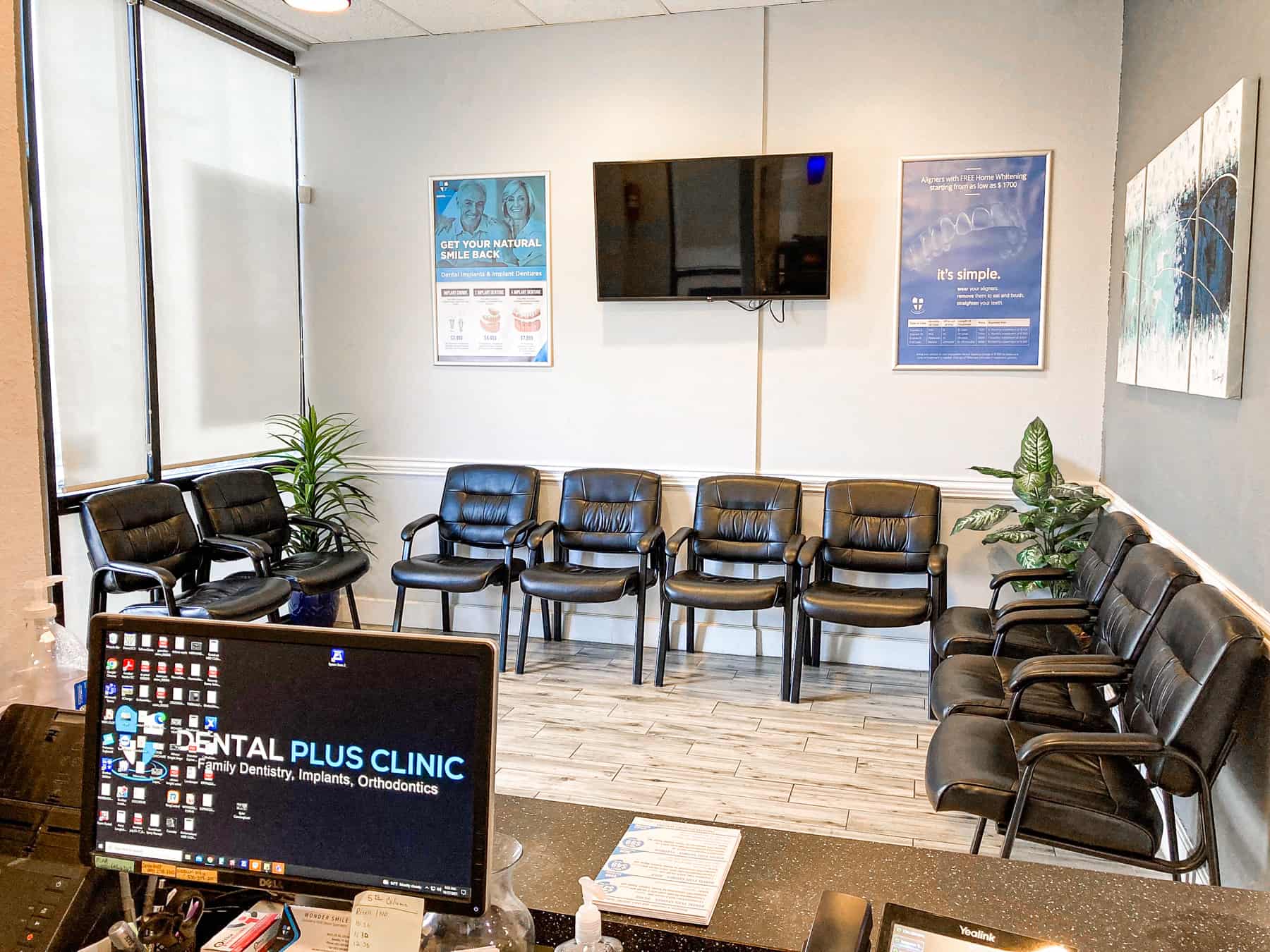
Patients at locations like Dental Plus Clinics can utilize savings plan discounts for comprehensive services ranging from routine cleanings to advanced procedures. The transparency of discount percentages allows patients to calculate their out-of-pocket costs before scheduling appointments.

Cost Comparison for Common Dental Procedures
The financial advantage of dental insurance vs dental savings plans varies significantly based on treatment types and frequency. For patients requiring minimal dental work, savings plans often prove more economical, while those needing expensive major procedures may benefit from insurance coverage limits.
Consider a patient needing a crown, two fillings, and routine preventive care annually. With dental insurance charging $600 in annual premiums plus a $100 deductible and 50% coinsurance on major work, total costs might reach $1,450. A savings plan with a $150 annual fee and 30% discount on the same procedures could cost $1,200, representing $250 in savings.
However, patients requiring multiple major procedures exceeding $3,000 in retail costs might maximize insurance benefits by hitting their annual maximum, potentially saving more than with discount plans alone. Comparing the mathematical breakdown of both approaches reveals how treatment needs influence cost-effectiveness.
Network Accessibility and Provider Choice
Provider networks significantly impact the practical value of both dental insurance and savings plans. Insurance plans typically maintain smaller, more restricted networks, while dental savings plans often provide broader access to participating dentists across multiple specialties.
For Texas residents across Beeville, New Braunfels, Leander, and surrounding communities, network availability determines which dental practices accept specific payment methods. Verifying that preferred providers participate in chosen plans prevents unexpected limitations when seeking care.
In-Network vs Out-of-Network Considerations
Dental insurance heavily penalizes out-of-network care through substantially reduced coverage percentages or complete exclusion from benefits. Patients visiting non-participating dentists may receive only 50% of the already-limited coverage or pay entirely out-of-pocket despite maintaining active insurance.
Dental savings plans eliminate this concern entirely since the membership only provides value at participating locations. However, the broader networks associated with most savings plans typically include more dental offices, increasing flexibility when selecting providers.
Network comparison factors:
- Insurance networks: 50-200 dentists in metropolitan areas
- Savings plan networks: 100-500 dentists in the same regions
- Specialist availability within each network
- Geographic coverage across multiple Texas cities
- Quality ratings and patient reviews for participating providers
Patients seeking comprehensive dental care services should verify network participation before enrolling in either option, ensuring their preferred clinic accepts the chosen payment method.
Finding Participating Providers in Texas
Locating participating dentists requires consulting provider directories maintained by insurance companies and savings plan organizations. These searchable databases allow filtering by location, specialty, and distance to identify convenient options near your residence or workplace.
Most plans provide online tools showing real-time network status, office contact information, and accepted payment methods. Calling dental offices directly confirms current participation status and prevents confusion during appointment scheduling.
For families requiring care across multiple Texas locations, selecting plans with broad geographic coverage ensures consistent access regardless of which city you visit. This flexibility proves particularly valuable for patients traveling between Beeville, Seguin, New Braunfels, Leander, and Converse for work or family commitments.
Evaluating Coverage for Specific Treatment Types
The debate between dental insurance vs dental savings plans intensifies when examining coverage for specific treatment categories. Certain procedures receive preferential treatment under insurance models, while others benefit more from discount plan structures.
Preventive Care and Routine Maintenance
Both payment methods generally provide strong value for preventive services, though through different mechanisms. Insurance typically covers preventive care at 100% with no deductible, while savings plans offer 15-30% discounts on these already affordable services.
For patients committed to biannual cleanings, annual exams, and periodic X-rays, insurance delivers slightly better value by eliminating out-of-pocket costs entirely. However, savings plans still reduce preventive care expenses significantly while avoiding monthly premium payments.
The financial difference narrows considerably when calculating annual costs. If preventive services total $350 per year retail, insurance covers them completely but charges $600 in premiums, resulting in $600 total cost. A savings plan with 25% discount reduces those services to $262.50 plus the $150 membership fee, totaling $412.50-representing $187.50 in savings.
Basic Procedures Like Fillings and Extractions
Basic restorative procedures demonstrate where savings plans frequently outperform insurance for cost-conscious patients. While insurance covers 70-80% after deductibles, the combined costs of premiums, deductibles, and coinsurance often exceed the discounted rates available through membership plans.
A filling costing $200 retail requires 20% coinsurance ($40) plus a portion of annual premiums ($600 ÷ 12 months × 12 = $600) and deductible ($100), creating substantial overhead. The same filling through a savings plan with 35% discount costs $130 plus the annual membership divided by anticipated procedures.

| Procedure Type | Retail Cost | Insurance Cost | Savings Plan Cost | Better Option |
|---|---|---|---|---|
| Single Filling | $200 | $40 + premiums/deductible | $130 (35% discount) | Savings Plan |
| Simple Extraction | $150 | $30 + premiums/deductible | $97.50 (35% discount) | Savings Plan |
| Root Canal | $800 | $160 + premiums/deductible | $520 (35% discount) | Insurance |
| Cleaning | $120 | $0 (covered) | $90 (25% discount) | Insurance |
Major Restorative and Cosmetic Treatments
Major procedures represent the most complex category when comparing dental insurance vs dental savings plans. Insurance coverage of 50% appears attractive until you consider annual maximums that cap benefits at $1,000-$2,000 regardless of total treatment costs.
Patients requiring crowns, bridges, or advanced dental implant procedures quickly exhaust insurance benefits, leaving them fully responsible for remaining expenses. A single implant costing $3,500 receives $1,000 insurance coverage (if maximum allows), leaving $2,500 out-of-pocket. The same implant through a savings plan with 30% discount costs $2,450-only $50 more without the hassle of insurance bureaucracy.
Cosmetic treatments like veneers, teeth whitening, and smile makeovers typically receive zero insurance coverage since they’re considered elective procedures. Dental savings plans provide 10-40% discounts on these services, making them the clear choice for aesthetic treatments. Patients exploring cosmetic options like veneers benefit substantially from membership discounts unavailable through traditional insurance.
Administrative Simplicity and Claims Processing
The administrative burden associated with dental insurance versus dental savings plans differs dramatically, affecting both patient experience and provider relationships. Insurance requires claim submissions, pre-authorizations, and extensive documentation, while savings plans operate on straightforward discount redemption.
Insurance Claims and Approval Processes
Dental insurance involves multi-step procedures where dentists submit treatment plans for pre-authorization, perform approved work, file claims with detailed codes and supporting documentation, then wait weeks or months for reimbursement processing. Patients often pay upfront and await insurance reimbursements, creating cash flow challenges.
Claims denials for various reasons-missing information, coding errors, coverage disputes-require appeals and extended negotiations between dental offices and insurance companies. This complexity frustrates both patients and providers, sometimes delaying necessary treatments while administrative issues resolve.
Common insurance complications include:
- Pre-authorization requirements for major procedures
- Claim denials requiring resubmission
- Coordination of benefits with multiple insurers
- Explanation of benefits confusion
- Reimbursement delays of 30-90 days
Simplified Payment with Discount Plans
Dental savings plans eliminate administrative complexity entirely. Patients present their membership cards, receive instant verification of discount percentages, and pay reduced rates directly at checkout. No claims, no waiting periods, no reimbursement delays-just immediate savings applied at the point of service.
This streamlined approach benefits both patients and dental practices by reducing paperwork, eliminating billing uncertainties, and providing transparent cost calculations before treatment begins. Dental offices appreciate the guaranteed payment and reduced administrative overhead compared to insurance processing requirements.
For practices like Dental Plus Clinic in Leander, accepting savings plans means faster payments, fewer billing complications, and improved patient satisfaction through transparent pricing. The simplicity encourages patients to proceed with recommended treatments rather than delaying care due to insurance confusion.
Flexibility and Customization Options
Personal dental needs vary significantly based on age, oral health status, treatment history, and future expectations. Evaluating dental insurance vs dental savings plans requires assessing which option provides greater flexibility for your unique circumstances and anticipated care requirements.
Family Coverage Considerations
Family dental coverage presents distinct considerations affecting cost-effectiveness calculations. Insurance family plans charge substantially higher premiums ($100-$150 monthly) but provide individual deductibles and maximums for each family member, potentially offering better value for families with multiple members requiring extensive care.
Dental savings plans charge flat annual fees regardless of family size, with some plans covering entire households for $150-$250 annually. For families with four or more members all requiring routine preventive care, savings plans deliver exceptional value by providing unlimited discounts without per-person premium multiplication.
Family coverage comparison:
- Insurance: Higher premiums but individual maximums for each member
- Savings Plans: Flat household fee covering all family members
- Best for large families: Savings plans with multiple users
- Best for families needing major work: Insurance with multiple maximums
- Geographic flexibility: Important for families across multiple Texas cities
Handling Pre-Existing Conditions
Pre-existing dental conditions create additional complexity when selecting payment methods. Traditional insurance often excludes coverage for conditions existing before policy enrollment or imposes extended waiting periods before covering related treatments.
Dental savings plans impose no such restrictions. All procedures receive immediate discounts regardless of when conditions developed or when symptoms appeared. This accessibility proves invaluable for patients with existing decay, gum disease, or structural damage requiring prompt attention.
Individuals with urgent dental needs benefit substantially from savings plans that activate immediately without excluding existing conditions from coverage. The ability to address problems promptly prevents complications and more expensive interventions later.
Long-Term Financial Planning for Dental Health
Strategic dental care planning extends beyond immediate costs to encompass long-term oral health maintenance and anticipated future treatments. Comparing dental insurance vs dental savings plans requires projecting dental needs across multiple years and calculating cumulative costs under each payment method.
Calculating Five-Year Cost Projections
Comprehensive financial analysis examines total expenditures over extended periods, accounting for premium payments, deductibles, copays, and out-of-pocket expenses under insurance versus membership fees and discounted procedure costs through savings plans.
Consider a patient requiring routine preventive care, occasional fillings, and one crown over five years. Insurance costs include $3,600 in premiums (60 months × $60), $500 in deductibles, and $800 in coinsurance, totaling $4,900. Savings plans charge $750 in membership fees (5 years × $150) plus $2,100 in discounted procedure costs, totaling $2,850-a savings of $2,050 over five years.
However, patients anticipating extensive major work exceeding $10,000 retail might benefit from insurance annual maximums providing $10,000 in cumulative benefits (5 years × $2,000), potentially offsetting premium costs despite ongoing monthly payments.
Budgeting for Unexpected Dental Emergencies
Emergency dental situations-sudden infections, traumatic injuries, urgent extractions-challenge both insurance and savings plan models differently. Insurance may cover emergency care subject to deductibles and coinsurance, while savings plans provide immediate discounts without waiting for claim approvals.
The absence of annual maximums in savings plans proves particularly valuable during emergency situations requiring multiple urgent procedures within short timeframes. Insurance maximums might exhaust quickly during emergencies, leaving patients responsible for additional costs regardless of their premium payments.
Planning for dental contingencies involves maintaining emergency funds regardless of payment method chosen. Neither insurance nor savings plans eliminate all out-of-pocket costs, making financial preparedness essential for comprehensive oral health management. Understanding how to reduce dental care costs through various strategies complements whichever primary payment method you select.
Making the Right Choice for Your Situation
Selecting between dental insurance and dental savings plans ultimately depends on individual circumstances, treatment needs, budget constraints, and personal preferences regarding administrative simplicity versus comprehensive coverage structures.
When Dental Insurance Makes More Sense
Traditional insurance delivers optimal value for specific patient profiles despite its complexity and cost. Individuals with employer-sponsored plans receiving premium subsidies often find insurance provides excellent value, particularly when employers cover 50-100% of premium costs.
Insurance proves advantageous when:
- Employers subsidize premiums significantly
- You require extensive major procedures annually
- Family members all need major restorative work
- You prefer predictable monthly costs over variable expenses
- Maximum annual benefits exceed total premium and out-of-pocket costs
Patients anticipating major procedures like multiple dental implants within a single year might maximize insurance benefits by concentrating treatments to fully utilize annual maximums before coverage resets.
When Dental Savings Plans Provide Better Value
Membership discount plans excel for patients requiring immediate access to affordable care without administrative barriers or waiting periods. The comparison between insurance and savings plans reveals distinct advantages for various demographic groups and treatment scenarios.
Savings plans outperform insurance for individuals who:
- Need immediate treatment without waiting periods
- Require primarily preventive and basic care
- Want coverage for cosmetic procedures
- Prefer simple, transparent pricing
- Lack employer-sponsored insurance options
- Want flexibility changing dentists freely
Self-employed individuals, retirees without dental benefits, and young adults maintaining good oral health typically save substantial amounts through discount plans compared to purchasing individual insurance policies with high premiums and limited benefits.
Combining Both Options Strategically
Some patients strategically maintain both dental insurance and savings plans simultaneously, using each for its optimal purpose. Insurance covers major procedures within annual limits while savings plans provide discounts on preventive care, cosmetic treatments, and additional work exceeding insurance maximums.
This hybrid approach works particularly well for individuals with employer-subsidized insurance covering major treatments but requiring additional work beyond annual caps. The savings plan supplements insurance coverage, providing discounts on overflow procedures and cosmetic enhancements not covered by traditional policies.
| Patient Profile | Best Option | Primary Reason |
|---|---|---|
| Employer-subsidized insurance | Keep insurance | Low net premium cost |
| Self-employed, minimal needs | Savings plan | Lower annual cost |
| Extensive major work needed | Insurance | Annual maximum benefits |
| Cosmetic treatments planned | Savings plan | Insurance excludes cosmetic |
| Immediate treatment required | Savings plan | No waiting periods |
| Large family, routine care | Savings plan | Flat household fee |
Regional Considerations for Texas Residents
Geographic location influences both the availability and value proposition of dental insurance vs dental savings plans. Texas residents encounter unique considerations based on provider density, regional cost variations, and local network participation across different metropolitan and rural areas.
Provider Networks Across Texas Cities
Major Texas metropolitan areas including Austin, San Antonio, and Houston maintain extensive networks for both insurance and savings plans, providing abundant provider choices and competitive pricing. Smaller cities and rural communities may encounter limited network participation, affecting accessibility regardless of payment method selected.
Patients residing in Beeville, Seguin, New Braunfels, Leander, and Converse benefit from regional dental practices participating in multiple payment systems, ensuring accessibility regardless of which option they choose. Verifying local provider participation before enrolling prevents access limitations that undermine payment plan value.
State-Specific Regulations and Consumer Protections
Texas maintains specific regulations governing both dental insurance and savings plans, establishing consumer protections and disclosure requirements that ensure transparency and fair treatment. Understanding these protections helps patients evaluate plans confidently and resolve disputes when necessary.
The Texas Department of Insurance oversees dental insurance policies, mandating clear disclosure of coverage limitations, exclusions, waiting periods, and annual maximums. Dental savings plans, classified differently under Texas law, must provide transparent fee schedules and clearly identify participating providers within their networks.
Patients experiencing difficulties with either payment method can file complaints with appropriate regulatory agencies, seeking resolution for coverage disputes, billing errors, or misleading marketing practices. These consumer protections ensure accountability regardless of which dental payment approach you select.
Evaluating Plan Quality and Provider Reputation
Beyond cost comparisons, evaluating the quality and reliability of specific insurance companies and savings plan organizations ensures you select reputable providers offering genuine value rather than misleading discount claims or inadequate coverage.
Researching Insurance Company Ratings
Major dental insurance providers receive ratings from independent agencies evaluating financial stability, customer service quality, claims processing efficiency, and overall satisfaction levels. Consulting these ratings before enrolling helps identify insurers with strong track records and reliable service delivery.
Key evaluation criteria include:
- Financial strength ratings from A.M. Best or Moody’s
- Customer satisfaction scores from J.D. Power
- Complaint ratios filed with state insurance departments
- Claims denial rates and appeals success percentages
- Network adequacy across your geographic area
Selecting highly-rated insurers minimizes risks of claim denials, reimbursement delays, and customer service frustrations that plague lower-quality providers despite competitive premium pricing.
Verifying Dental Savings Plan Legitimacy
The dental savings plan industry includes both reputable organizations and questionable operators making exaggerated discount claims or maintaining inadequate provider networks. Thorough research before enrollment prevents disappointment and financial waste on memberships delivering minimal value.
Detailed comparisons between savings plans and insurance help identify legitimate organizations offering genuine discounts through contractual agreements with participating dentists. Verify claimed discount percentages by calling dental offices directly and confirming their participation and actual fees charged to plan members.
Accreditation through organizations like the Better Business Bureau, positive customer reviews across multiple platforms, and transparent fee schedules accessible before enrollment indicate reputable savings plan providers worthy of consideration.
Understanding Annual Enrollment Periods and Changes
Timing significantly affects when you can enroll in dental insurance versus dental savings plans, with distinct rules governing enrollment windows, coverage effective dates, and mid-year changes that impact accessibility and strategic planning.
Insurance Open Enrollment Limitations
Employer-sponsored dental insurance typically restricts enrollment to annual open enrollment periods lasting two to four weeks, during which employees can add, modify, or cancel coverage for the upcoming plan year. Missing open enrollment often means waiting an entire year before making changes unless qualifying life events occur.
Individual dental insurance purchased directly through carriers or healthcare marketplaces may allow year-round enrollment but often imposes waiting periods before coverage activates. These restrictions limit flexibility for individuals experiencing sudden dental needs or recognizing coverage gaps mid-year.
Year-Round Savings Plan Enrollment
Dental savings plans offer unrestricted year-round enrollment with immediate activation, typically within 24-72 hours of joining. This flexibility proves invaluable for patients discovering urgent dental needs, experiencing insurance coverage gaps, or relocating to areas where previous plans lack participating providers.
The ability to enroll anytime without waiting periods makes savings plans particularly attractive during dental emergencies requiring prompt treatment. Patients can join, receive immediate discounts, complete necessary procedures, and evaluate whether maintaining membership provides ongoing value for future care needs.
Impact on Preventive Care Utilization
Payment method selection influences how frequently patients seek preventive dental care, affecting long-term oral health outcomes and overall treatment costs. Understanding these behavioral patterns helps appreciate the broader implications of choosing between dental insurance vs dental savings plans.
Insurance Coverage Encouraging Regular Visits
The 100% coverage dental insurance provides for preventive services theoretically encourages regular dental visits by eliminating financial barriers to cleanings and examinations. Patients maximizing preventive benefits maintain better oral health, potentially avoiding expensive restorative procedures later.
However, monthly premiums, administrative complexity, and network limitations sometimes discourage insurance holders from scheduling appointments despite having coverage. The perception that insurance makes care “free” can paradoxically reduce utilization when overall insurance costs and hassles outweigh perceived benefits of routine visits.
Savings Plan Accessibility Promoting Consistent Care
Dental savings plans promote preventive care accessibility through transparent, affordable pricing that encourages regular appointments without claim submissions or coverage uncertainties. The straightforward discount application and absence of deductibles lower psychological barriers to scheduling cleanings and checkups.
For cost-conscious patients, knowing exactly what they’ll pay before arriving encourages appointment scheduling and treatment acceptance. This predictability supports consistent preventive care habits that maintain oral health and prevent more expensive problems from developing undetected.
Practices emphasizing preventive care, like those offering comprehensive dental services, partner with both insurance networks and savings plans to maximize patient accessibility regardless of payment preferences. Supporting multiple payment methods ensures financial considerations don’t prevent patients from receiving essential preventive care.
Special Considerations for Seniors and Retirees
Medicare’s exclusion of dental coverage creates unique challenges for seniors and retirees evaluating dental payment options. The comparison between dental insurance vs dental savings plans takes on distinct dimensions for older adults with specific oral health needs and fixed incomes.
Medicare Limitations and Alternative Coverage
Traditional Medicare Parts A and B exclude routine dental care, leaving seniors responsible for finding alternative coverage through Medicare Advantage plans, standalone dental insurance, or dental savings plans. Understanding options for seniors helps retirees make informed decisions balancing cost and coverage.
Medicare Advantage plans sometimes include limited dental benefits, though coverage often remains minimal compared to standalone dental insurance or comprehensive savings plans. Evaluating the dental component of Medicare Advantage requires careful examination of coverage limitations, network restrictions, and out-of-pocket costs.
Fixed Income Budget Considerations
Retirees living on fixed incomes prioritize predictable expenses and maximum value from healthcare expenditures. Dental savings plans often appeal to seniors through low annual fees, immediate activation, and transparent pricing that facilitates budget planning and financial management.
The absence of monthly premiums allows retirees to allocate dental funds only when seeking care rather than maintaining continuous insurance payments regardless of utilization. This flexibility proves particularly valuable for seniors with unpredictable dental needs who want affordable access without ongoing financial commitments.
Final Thoughts
Choosing between dental insurance and dental savings plans requires careful analysis of your specific dental needs, budget constraints, and treatment frequency. While traditional insurance offers valuable coverage for major procedures within annual limits, savings plans provide immediate accessibility, transparent pricing, and unlimited discount potential without administrative complexity. Whether you prioritize comprehensive coverage or straightforward affordability, understanding both options empowers you to make confident decisions about your oral health financing. At Dental Plus Clinic, we accept multiple payment methods across our five Texas locations, ensuring every patient can access exceptional dental care regardless of their chosen payment approach. Schedule your consultation today to discuss which option best supports your journey toward optimal oral health.