
Dental implants have revolutionized restorative dentistry, offering patients a permanent solution for missing teeth that looks, feels, and functions like natural teeth. When considering dental implant treatment, one of the most important decisions involves choosing between implant materials. The zirconia vs titanium implants debate has gained significant attention in recent years as both materials offer distinct advantages for different patient needs. Understanding the differences between these two options can help you make an informed decision about your oral health investment. This comprehensive guide explores the critical factors that distinguish zirconia from titanium implants, including biocompatibility, aesthetics, strength, longevity, and cost considerations.
Material Composition and Properties
Titanium Implant Characteristics
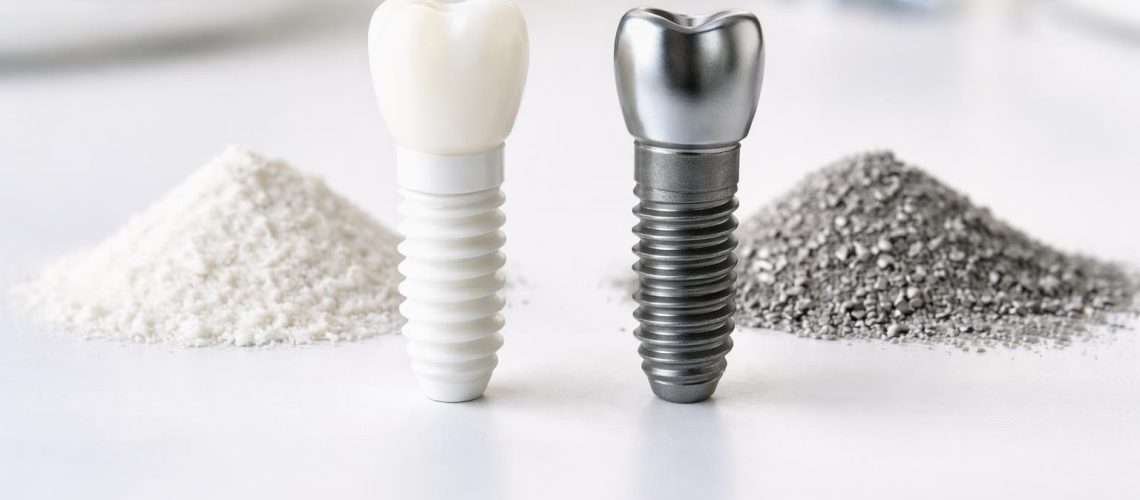
Titanium has been the gold standard in dental implantology for over five decades. This metal possesses unique properties that make it ideal for osseointegration, the process by which the implant fuses with the jawbone. Titanium implants are typically made from commercially pure titanium or titanium alloy, which combines titanium with small amounts of aluminum and vanadium to enhance strength.
The material’s exceptional biocompatibility stems from its ability to form a stable oxide layer on its surface when exposed to air or bodily fluids. This protective layer prevents corrosion and allows bone cells to attach directly to the implant surface. Research has consistently shown that titanium implants achieve predictable osseointegration rates exceeding 95% in most clinical scenarios.
Key properties of titanium implants include:
- High tensile strength and fracture resistance
- Excellent long-term durability spanning decades
- Proven track record with extensive clinical documentation
- Ability to support immediate loading protocols in certain cases
- Compatibility with various surface treatments to enhance bone integration
Zirconia Implant Composition
Zirconia implants represent a newer alternative in implant dentistry, made from zirconium dioxide, a ceramic material that has been used in orthopedic surgery for hip and knee replacements. The specific type used in dental implants is yttria-stabilized tetragonal zirconia polycrystal, often abbreviated as Y-TZP.
This white ceramic material offers a metal-free option that appeals to patients with metal sensitivities or those seeking a more natural appearance. Zirconia implants are typically manufactured as one-piece systems, though two-piece designs have recently entered the market. The material undergoes specialized processing to achieve the necessary strength and stability for dental applications.
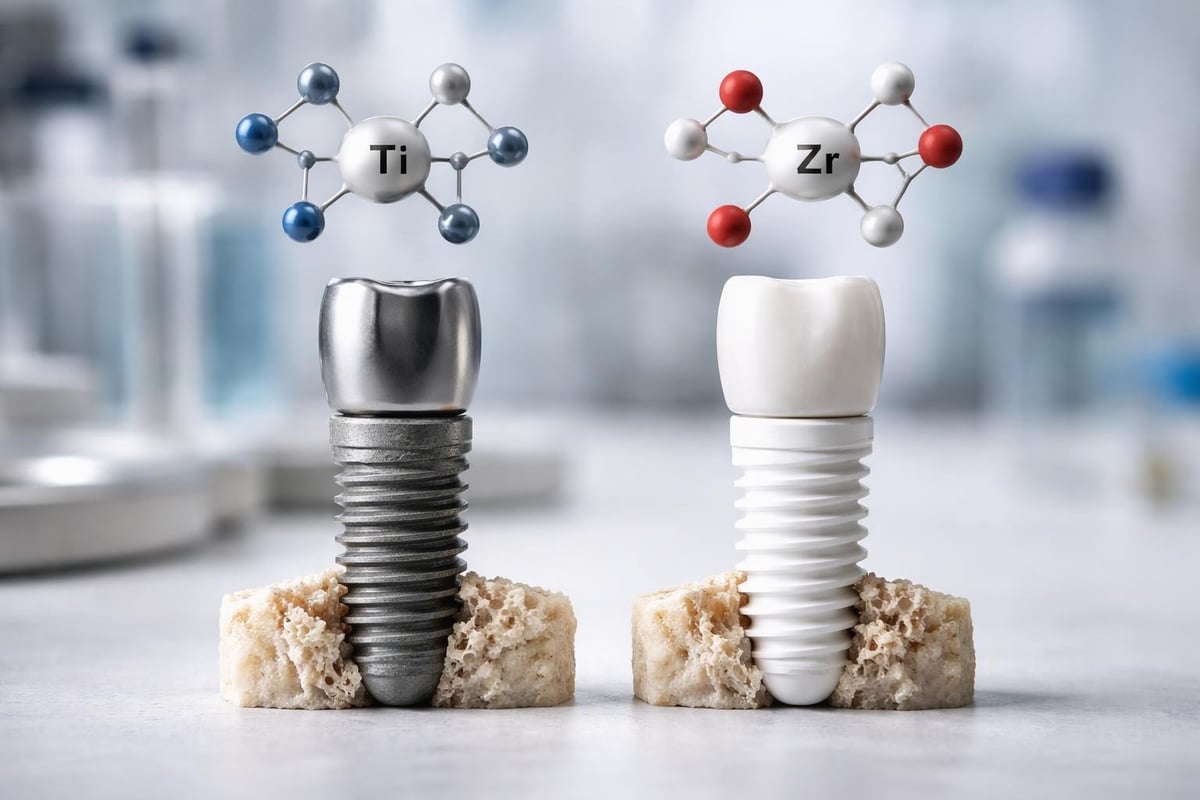
According to a systematic review comparing the clinical performance of both materials, zirconia implants have shown promising results in controlled clinical trials, though the long-term data remains more limited compared to titanium.
Biocompatibility and Tissue Response
Osseointegration Capacity
Both materials demonstrate excellent biocompatibility, though they achieve bone integration through different mechanisms. Titanium achieves osseointegration through direct bone-to-implant contact, facilitated by the oxide layer that forms on its surface. The bone cells recognize this layer as compatible and attach directly to it, creating a strong mechanical bond.
Zirconia implants also promote osseointegration, with bone cells attaching to the ceramic surface. Studies examining hard and soft tissue integration in preclinical models suggest that zirconia may offer comparable or even superior soft tissue response compared to titanium, with reduced plaque accumulation and bacterial adhesion on the ceramic surface.
The debate surrounding zirconia vs titanium implants often centers on their respective integration timelines. Titanium implants typically require 3-6 months for complete osseointegration, while zirconia implants may need similar or slightly longer healing periods, depending on the specific product and patient factors.
Immune Response and Sensitivity
One significant advantage of zirconia implants is their hypoallergenic nature. While true titanium allergies are rare, affecting less than 1% of the population, some patients experience sensitivity reactions that can compromise implant success. Symptoms may include inflammation, pain, or implant failure in susceptible individuals.
Zirconia’s ceramic composition eliminates this concern entirely, making it an excellent choice for patients with documented metal sensitivities or those who prefer a metal-free restoration. The material shows no evidence of triggering immune responses or causing systemic reactions, even in patients with multiple chemical sensitivities.
| Biocompatibility Factor | Titanium | Zirconia |
|---|---|---|
| Osseointegration success rate | 95-98% | 92-95% |
| Metal allergy risk | Minimal (<1%) | None |
| Soft tissue response | Good | Excellent |
| Bacterial adhesion | Moderate | Low |
| Long-term data availability | Extensive (50+ years) | Limited (15 years) |
Aesthetic Considerations
Color and Natural Appearance
Aesthetics play a crucial role in anterior tooth replacement, where the implant and restoration must blend seamlessly with surrounding natural teeth. This is where zirconia holds a distinct advantage in the zirconia vs titanium implants comparison. Zirconia’s white color closely resembles natural tooth structure, preventing the gray shadowing that can occur with titanium implants, especially in patients with thin gingival biotype or gum recession.
Titanium’s metallic gray color can show through the gum tissue in certain situations, creating an unnatural appearance that compromises the aesthetic result. This becomes particularly problematic in the smile line, where even subtle discoloration is noticeable. Dental professionals often need to use additional soft tissue grafting or thicker abutments to mask titanium implants in aesthetic zones.
For patients seeking comprehensive dental implant solutions, understanding these aesthetic differences helps set realistic expectations for treatment outcomes.
Gingival Response and Peri-Implant Health
The soft tissue surrounding dental implants, known as peri-implant mucosa, responds differently to titanium and zirconia materials. Research indicates that zirconia surfaces may promote healthier gingival attachment with reduced inflammation markers compared to titanium. The ceramic material’s smooth surface and low plaque affinity contribute to better long-term soft tissue stability.
Titanium implants can accumulate more bacterial biofilm, potentially increasing the risk of peri-implantitis, an inflammatory condition affecting the tissues around implants. However, proper oral hygiene and regular professional maintenance can effectively minimize this risk with either material.
Factors affecting aesthetic outcomes:
- Gingival thickness and biotype
- Implant placement depth and angulation
- Abutment material selection
- Bone levels and stability over time
- Patient’s smile line and lip dynamics
Strength and Durability Analysis
Mechanical Properties Comparison
When evaluating zirconia vs titanium implants from a mechanical standpoint, titanium demonstrates superior fracture toughness and resistance to fatigue loading. Titanium’s metallic structure allows it to bend slightly under extreme force rather than fracture, providing a margin of safety in high-stress situations. This property makes titanium particularly suitable for posterior restorations where chewing forces are greatest.
Zirconia, being a ceramic material, exhibits excellent compressive strength but is more brittle than titanium. While modern zirconia formulations have significantly improved fracture resistance, the material remains more susceptible to catastrophic failure under extreme lateral forces or impact. Studies measuring primary stability factors like insertion torque show that both materials can achieve adequate initial stability, though the long-term mechanical behavior differs.
One-piece zirconia implants eliminate the microgap present in two-piece titanium systems, potentially reducing bacterial colonization at the implant-abutment interface. However, this design limits prosthetic flexibility and makes retrieval more challenging if complications arise.
Clinical Performance Over Time
Titanium implants boast survival rates exceeding 95% at 10 years and approximately 90% at 20 years when properly placed and maintained. This extensive clinical track record provides confidence in their long-term predictability. The material’s ability to withstand occlusal forces, environmental factors, and physiological changes over decades has been thoroughly documented across diverse patient populations.
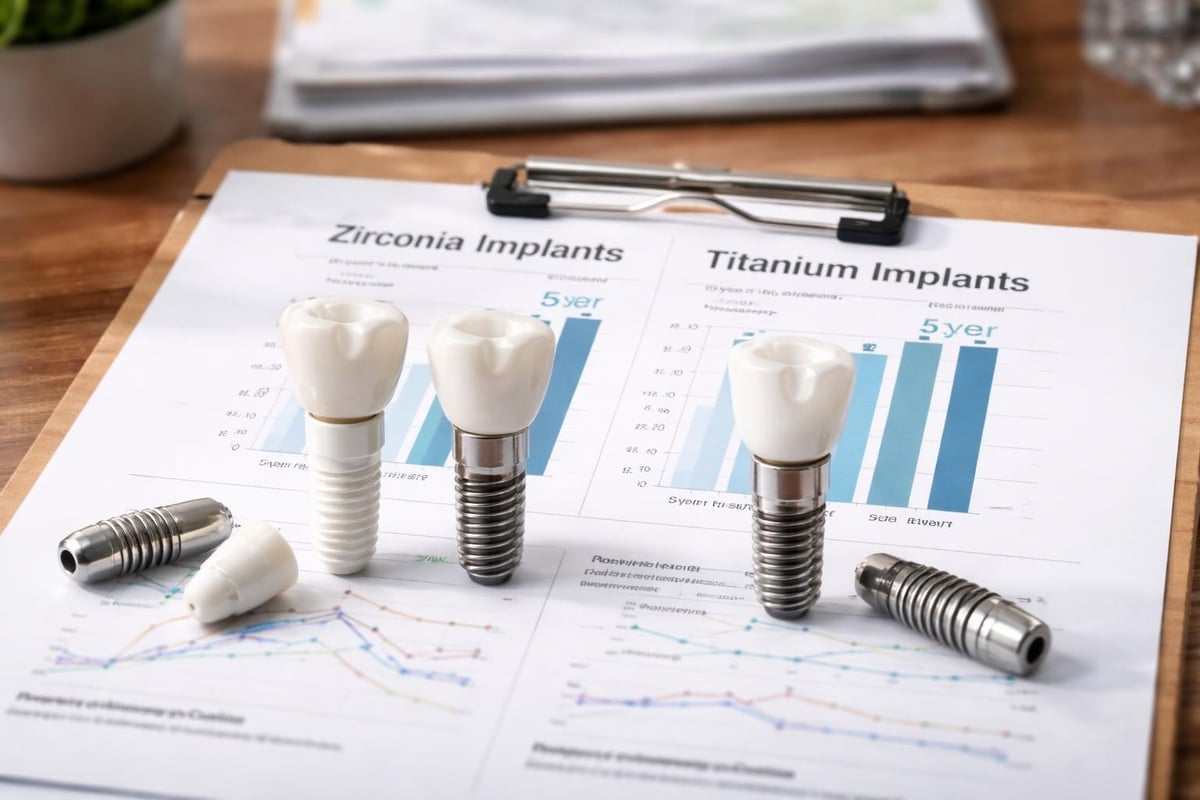
Zirconia implants, while showing promising medium-term results, lack the decades of longitudinal data available for titanium. Research assessing survival and success rates indicates that well-designed zirconia implants can achieve comparable outcomes to titanium in the 5-10 year timeframe, though questions remain about their performance beyond 15 years.
| Mechanical Property | Titanium | Zirconia |
|---|---|---|
| Flexural strength | 900-1200 MPa | 800-1000 MPa |
| Fracture toughness | High | Moderate |
| Fatigue resistance | Excellent | Good |
| Impact resistance | Superior | Lower |
| Design flexibility | Two-piece standard | Primarily one-piece |
Clinical Applications and Indications
Ideal Scenarios for Titanium Implants
Titanium implants remain the preferred choice for many clinical situations, particularly those involving complex cases or challenging anatomical conditions. Their proven performance makes them suitable for nearly all implant applications, from single-tooth replacements to full-arch rehabilitations.
Optimal titanium implant applications include:
- Posterior tooth replacement with high occlusal forces
- Immediate loading protocols requiring immediate function
- Cases involving bone augmentation or grafting procedures
- Patients with bruxism or parafunctional habits
- Full-arch restorations like All-on-4 or All-on-6 systems
For patients exploring comprehensive full-arch solutions, titanium’s mechanical properties and versatility make it the standard choice. The material’s compatibility with various surgical protocols and prosthetic options provides treatment flexibility that benefits both patients and clinicians.
Ideal Scenarios for Zirconia Implants
Zirconia implants excel in situations where aesthetics are paramount or metal-free restoration is desired. Their application continues to expand as manufacturers refine designs and accumulate clinical evidence supporting their use in broader scenarios.
The zirconia vs titanium implants decision often favors zirconia in these situations:
- Anterior tooth replacement in the aesthetic zone
- Patients with documented metal sensitivities or allergies
- Individuals requesting biocompatible, metal-free dentistry
- Cases with thin gingival tissue where metal show-through is likely
- Single-tooth restorations in low-to-moderate stress areas
Patients interested in comprehensive information about zirconia options can benefit from understanding both the advantages and limitations of ceramic implant systems. The one-piece design of most zirconia implants makes them particularly suitable for immediate placement protocols in extraction sockets, where the implant and temporary restoration can be placed in a single appointment.
Cost Considerations and Value
Initial Investment Comparison
The financial aspect of the zirconia vs titanium implants discussion involves multiple factors beyond the implant material itself. Generally, titanium implants cost less than zirconia implants due to established manufacturing processes, widespread availability, and market competition among multiple manufacturers.
Zirconia implants typically command a premium price, reflecting the specialized manufacturing required, smaller market share, and positioning as a premium aesthetic option. The price difference varies by region, practitioner, and specific product, but patients can expect to pay 20-40% more for zirconia implants compared to titanium alternatives.
However, the total treatment cost extends beyond the implant fixture to include:
- Diagnostic imaging and treatment planning
- Surgical placement fees
- Abutment and crown fabrication
- Bone grafting or augmentation if needed
- Follow-up appointments and maintenance
When comparing dental implants vs other tooth replacement options, both titanium and zirconia implants represent significant investments that offer superior function and longevity compared to removable alternatives.
Long-Term Value Assessment
While zirconia implants carry higher upfront costs, their value proposition depends on individual patient priorities and circumstances. For patients highly concerned about aesthetics or metal sensitivity, the additional investment may be worthwhile. The potential for reduced peri-implantitis risk and superior soft tissue response could translate to lower long-term maintenance costs.
Titanium implants offer excellent long-term value based on their proven durability and predictability. The extensive clinical evidence supporting their longevity provides confidence that properly maintained titanium implants can last a lifetime, making the cost-per-year relatively low when amortized over decades of service.
| Cost Factor | Titanium | Zirconia |
|---|---|---|
| Average implant cost | $1,500-$2,500 | $2,000-$3,500 |
| Availability of options | Extensive | Limited |
| Replacement part availability | Readily available | More restricted |
| Long-term maintenance | Standard | Potentially lower |
| Overall value rating | Excellent | Good to excellent |
Success Rates and Clinical Evidence
Current Research Findings
The scientific literature comparing zirconia vs titanium implants continues to evolve as researchers accumulate longer-term data on ceramic implant systems. Systematic reviews and meta-analyses examining clinical performance have found that both materials achieve favorable outcomes when properly selected and placed, though differences exist in specific parameters.
Titanium implants benefit from thousands of published studies spanning multiple decades, establishing clear benchmarks for success rates, complication patterns, and predictable outcomes across diverse patient populations. This evidence base provides clinicians with confidence when treatment planning and helps patients understand realistic expectations.
Zirconia implant research, while growing rapidly, remains more limited in scope and duration. Most studies report short-to-medium-term outcomes, typically ranging from 1-10 years of follow-up. Analyses comparing treatment outcomes among different implant materials suggest that modern zirconia implants perform comparably to titanium in carefully selected cases, though the evidence supporting their use in challenging situations remains less robust.
Complication Patterns
Understanding potential complications helps patients make informed decisions about implant material selection. Titanium implants can experience biological complications like peri-implantitis, mechanical issues including screw loosening or fracture, and aesthetic challenges related to soft tissue recession exposing the metal surface.
Zirconia implants show lower rates of peri-implant inflammation in some studies, potentially due to reduced bacterial adhesion on ceramic surfaces. However, their one-piece design presents challenges if complications arise, as the implant cannot be easily modified or repaired. Fracture, while uncommon with modern formulations, represents a more serious complication with zirconia since the material fails catastrophically rather than gradually.
Common complications by material:
- Titanium: Peri-implantitis, screw loosening, abutment fracture, aesthetic compromise, metal sensitivity reactions (rare)
- Zirconia: Implant fracture, limited prosthetic options, difficulty with retrievability, higher technical sensitivity during placement
Patient Selection and Treatment Planning
Evaluating Candidate Suitability
Proper patient selection significantly influences outcomes regardless of which material is chosen in the zirconia vs titanium implants decision. Comprehensive evaluation includes assessing bone quality and quantity, occlusal forces, aesthetic demands, medical history, and patient expectations.
Patients with adequate bone volume, normal healing capacity, and realistic expectations are suitable candidates for either material. Those with compromised bone requiring extensive grafting, heavy occlusal forces from bruxism, or systemic conditions affecting healing may be better served by titanium implants due to their superior mechanical properties and extensive supporting evidence.
Aesthetic demands guide material selection in the anterior region, where zirconia’s white color provides advantages for patients with thin tissue or high smile lines. Conversely, posterior restorations subject to heavy chewing forces may benefit from titanium’s superior fracture resistance and two-piece design flexibility.
Customized Treatment Approaches
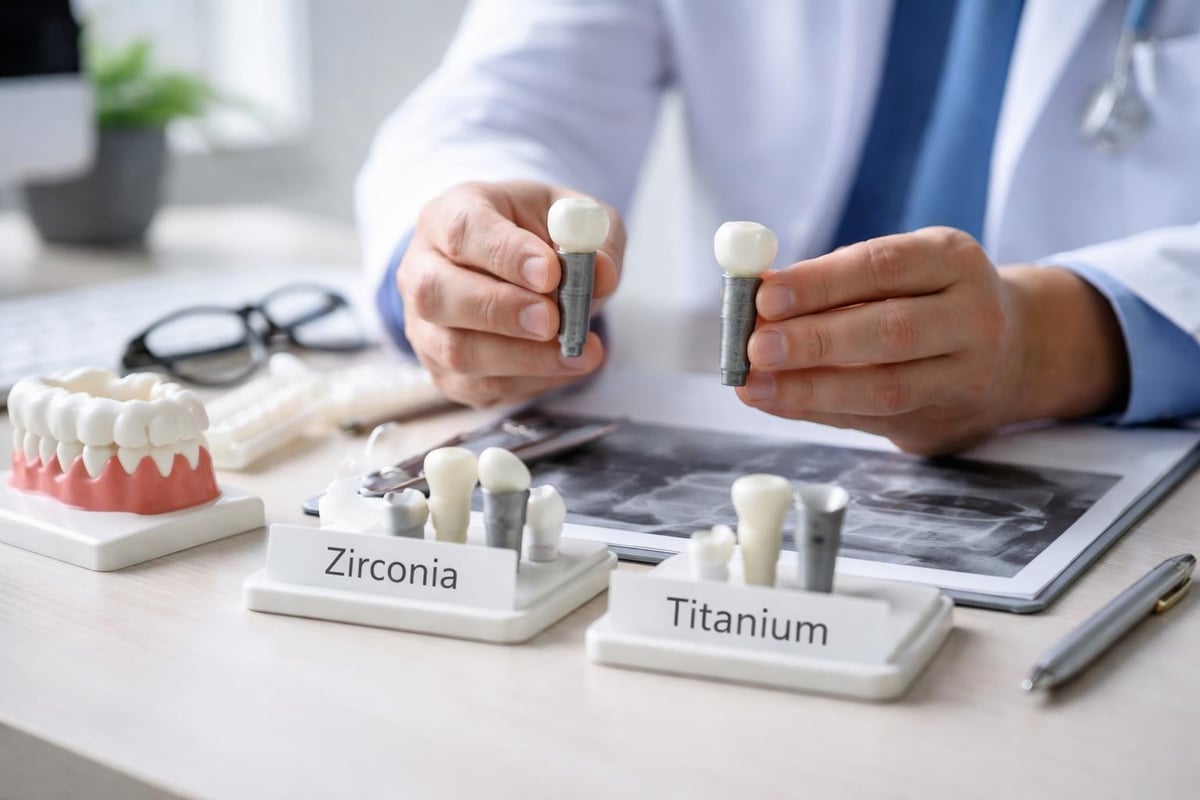
Modern implant dentistry recognizes that optimal outcomes often involve customizing material selection to individual patient needs rather than applying a one-size-fits-all approach. Some patients may benefit from using different materials in different locations, selecting titanium for posterior implants while choosing zirconia for highly visible anterior teeth.
The treatment planning process at advanced practices involves:
- Comprehensive clinical and radiographic examination
- Assessment of aesthetic risk factors and expectations
- Evaluation of occlusal patterns and parafunctional habits
- Discussion of material options with advantages and limitations
- Development of a personalized treatment plan aligned with patient priorities
For patients requiring bone grafting procedures to achieve adequate implant support, titanium may offer advantages due to its extensive documentation in augmented sites and compatibility with various grafting protocols.
Surgical and Prosthetic Considerations
Placement Protocols
The surgical protocols for titanium and zirconia implants share many similarities but differ in specific technical requirements. Both materials require precise osteotomy preparation, adequate primary stability, and careful attention to three-dimensional positioning. However, zirconia’s brittleness demands gentler insertion techniques to avoid fracture during placement.
Titanium implants tolerate a wider range of insertion torques and placement techniques, providing more forgiveness during surgery. Their two-piece design allows for post-placement adjustments and angled abutments to correct less-than-ideal positioning. Immediate loading protocols have been extensively validated with titanium implants, though careful patient selection remains critical for success.
Zirconia implants, predominantly one-piece designs, require extremely accurate placement since the restoration angle is determined at surgery. This increased technical sensitivity means that even small positioning errors cannot be easily corrected after placement. Some newer two-piece zirconia systems address this limitation but remain less common than monolithic designs.
Prosthetic Restoration Options
The prosthetic phase reveals another distinction in the zirconia vs titanium implants comparison. Titanium’s two-piece design offers extensive flexibility in restoration approaches, supporting screw-retained crowns, cement-retained crowns, custom abutments, and angled corrections. This versatility proves valuable when dealing with challenging angulations or aesthetic demands.
Zirconia one-piece implants limit prosthetic options to cement-retained restorations, eliminating the access channel required for screw retention. While this creates a more aesthetic result without a screw access hole, it also means the restoration cannot be easily retrieved for repair or replacement. Cementation techniques and cement removal become critical to prevent peri-implant complications.
Prosthetic considerations by material:
- Titanium: Multiple abutment options, screw or cement retention, easy retrievability, established laboratory workflows, compatibility with all crown materials
- Zirconia: Limited to cement retention in one-piece designs, restricted angulation correction, aesthetic abutment integration, specialized laboratory requirements
Future Developments and Innovations
Emerging Technologies
The dental implant field continues to evolve with ongoing research aimed at optimizing both titanium and zirconia systems. Surface modifications represent a major area of advancement, with treatments designed to enhance osseointegration speed, bone-to-implant contact percentage, and soft tissue integration. Titanium implants now feature various surface textures, coatings, and biochemical modifications that accelerate healing and improve outcomes.
Zirconia implant manufacturers are addressing earlier limitations through improved material formulations, enhanced surface treatments, and the development of two-piece systems that combine ceramic aesthetics with prosthetic flexibility. These innovations aim to expand the clinical indications for zirconia while maintaining its hypoallergenic and aesthetic advantages.
Contemporary dental implant technology incorporates digital planning, guided surgery, and customized prosthetics that enhance precision and predictability regardless of material selection. Computer-aided design and manufacturing enable patient-specific solutions that maximize both function and aesthetics.
Shifting Clinical Paradigms
As evidence accumulates regarding the performance of different implant materials, clinical guidelines continue to evolve. The zirconia vs titanium implants debate is becoming less polarized as practitioners recognize that both materials have appropriate applications based on patient-specific factors. Rather than viewing one material as universally superior, the trend moves toward individualized material selection guided by comprehensive assessment.
Future developments may include hybrid systems combining the mechanical advantages of titanium with the aesthetic benefits of ceramic materials. Research into surface modifications that reduce bacterial adhesion on titanium implants could narrow the soft tissue response gap compared to zirconia. Similarly, stronger zirconia formulations may expand ceramic implant applications into higher-stress situations currently dominated by titanium.
Making an Informed Decision
Questions to Ask Your Dentist
Patients considering dental implants should engage in thorough discussions with their dental provider about material selection. Understanding the rationale behind recommendations helps ensure alignment between clinical judgment and patient values.
Important questions include:
- Which material do you recommend for my specific situation and why?
- What is your experience with both titanium and zirconia implants?
- How will the implant material affect the aesthetic outcome in my case?
- What are the potential complications specific to each material option?
- How does the cost difference compare to the expected benefits?
- What does the research evidence show for my particular clinical scenario?
- How will material choice affect the timeline and healing process?
- What maintenance requirements differ between the materials?
Balancing Priorities
The optimal choice in the zirconia vs titanium implants discussion depends on weighing multiple factors according to individual priorities. Patients who prioritize proven longevity and mechanical reliability may prefer titanium despite minor aesthetic compromises. Those who value metal-free restoration and superior aesthetics may accept zirconia’s higher cost and slightly less extensive evidence base.
Neither material is inherently “better” in all situations-the best choice emerges from careful analysis of specific clinical circumstances, patient preferences, and realistic outcome expectations. Working with an experienced implant dentist who offers both materials and provides objective guidance ensures that the selected option aligns with individual needs and goals.
For patients in Texas seeking expert consultation on implant options, practices with comprehensive experience in both materials can provide personalized recommendations based on thorough evaluation and current evidence.
Final Thoughts
Both zirconia and titanium implants offer effective solutions for tooth replacement, each with distinct advantages that benefit different patient situations. Understanding the key differences in aesthetics, biocompatibility, strength, and cost helps you make a confident decision aligned with your oral health goals. At Dental Plus Clinic, our experienced team evaluates each patient’s unique needs to recommend the most appropriate implant material, ensuring optimal outcomes that combine function, aesthetics, and longevity. With locations across Texas and a commitment to advanced dental solutions, we’re ready to guide you through every step of your implant journey-schedule a consultation at Dental Plus Clinic to explore which implant option is right for you.